Check It Out at the Library: Preparing for the Last Cycle of Life
Reprinted by permission of the Patagonia Regional Times. Written by Sarah Klingenstein
“Our ultimate goal, after all, is not a good death but a good life to the very end.”
― Atul Gawande, Being Mortal: Medicine and What Matters in the End
It comes to this for us all: how do we help ourselves, our parents and other loved ones exit the world in a gentle way that maintains their dignity and integrity to the end?
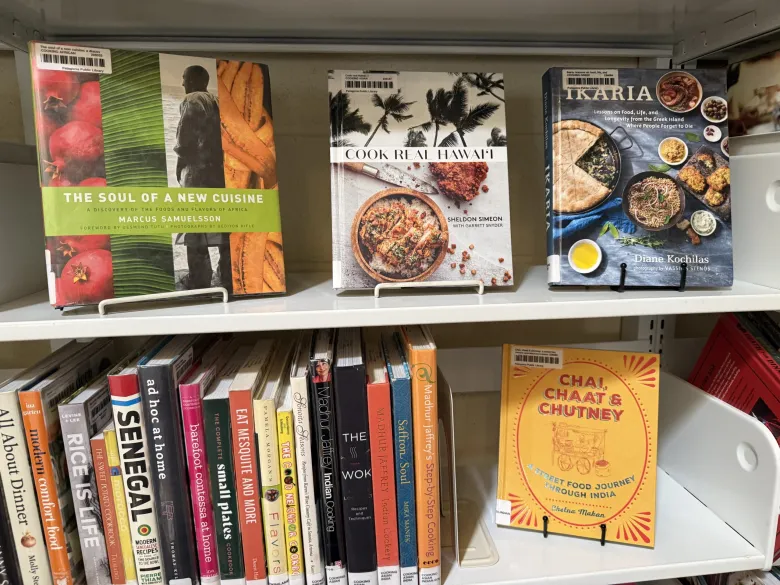
Some preparation is in order. And the Patagonia Public Library is well-stocked with resources to help you navigate:
- elder care (caregiving and dementia/Alzheimer’s)
- estate planning (financial and legal issues)
- creating a “good death” and a memorial for ourselves and our loved ones
- navigating the medical system
- coping with grief
Before highlighting a few popular titles, I’ll share that the Patagonia Public Library organizes the nonfiction titles in the Reading Room by topic and subtopic, not by the Dewey Decimal System that many are familiar with. The Library staff can steer you to the books you are seeking. Below, I’ll note the section where I found each book.
Being Mortal, by Atul Gawande, the author, a physician himself, lays bare the ways that the medical miracles of the last few centuries have made aging and death clinical problems to overcome, with sometimes little regard for the quality of the life of the patient. He examines aging and dying in our country and offers suggestions for a more humane way to care for our elders. Written in a natural and conversational style, it is very readable. Many readers have said the book transformed their perspective on our later years. (Social Science.Death.Dying)
The Gentle Art of Swedish Death Cleaning by the recently deceased Margareta Magnusson, is not about clearing the dust bunnies from under the couch before we die, nor is it just about giving away our old clothes. Cultivating an acceptance of our mortality is the first step, as we cast a fond look towards those who follow us, and whose lives we genuinely want to make easier. Then Magnusson outlines the more practical steps, from prioritizing which areas to tackle first and next, to getting your papers in order, which makes life easier for your family, to having discussions with them about your decisions to say goodbye to certain possessions. (House.Home Cleaning )
In our modern world, dying can be a complicated and for some, a lengthy process. The title of this next book says it all: Caring for Yourself While Caring for Your Aging Parents: How to Help, How to Survive by Claire Berman (Family.Relationships.Eldercare)
Some other titles include Reimagining Death, Travelers to Unimaginable Lands – Stories of Dementia, The Caregiver, and the Human Brain, and The Journey through Grief.
The Library has an expansive list of pertinent books and materials. Ask for this handout at the front desk.
Check It Out at the Library: What’s New
Reprinted by permission of the Patagonia Regional Times. Written by the Library Team
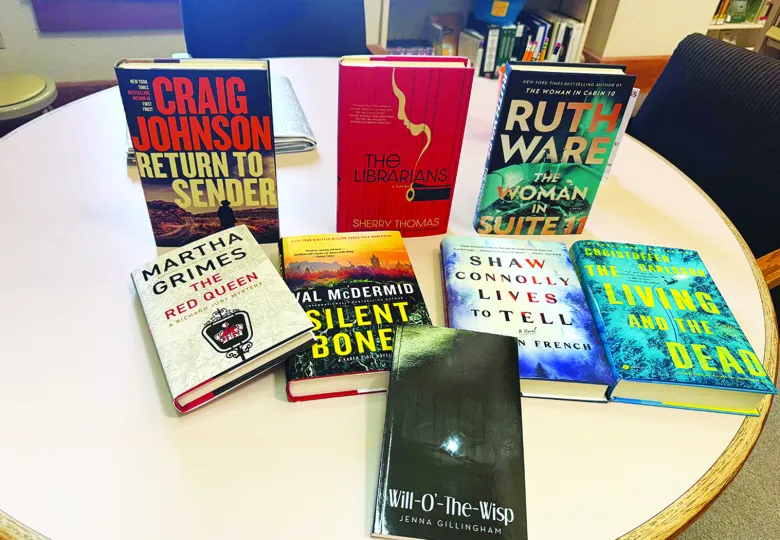
Looking for something to read to welcome in the new year? We just received a shipment of highly acclaimed bestsellers including:
“Silent Bones” by Val McDermid
“The Librarians” by Sherry Thomas
“Woman in Suite 11” by Ruth Ware
“The Red Queen” by Martha Grimes
“Will-O-The Wisp” by Jenna Gillingham
“The Living and the Dead” by Christopher Carlson
“Shaw Connolly Lives to Tell” by Gilliam French
And the eagerly anticipated latest from Craig Johnson, “Return to Sender”.
Rather watch a movie or a TV series instead? We have almost 2,000 titles in our collection so you’re sure to find something to pique your interest.
We hope you drop by next time you’re in the ‘hood to check out the latest additions to our collections.
The Way It Was
Reprinted by permission of the Patagonia Regional Times. Sondra Porter, author
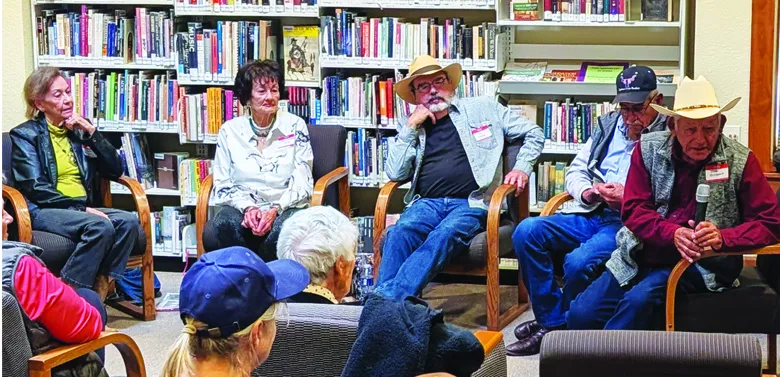
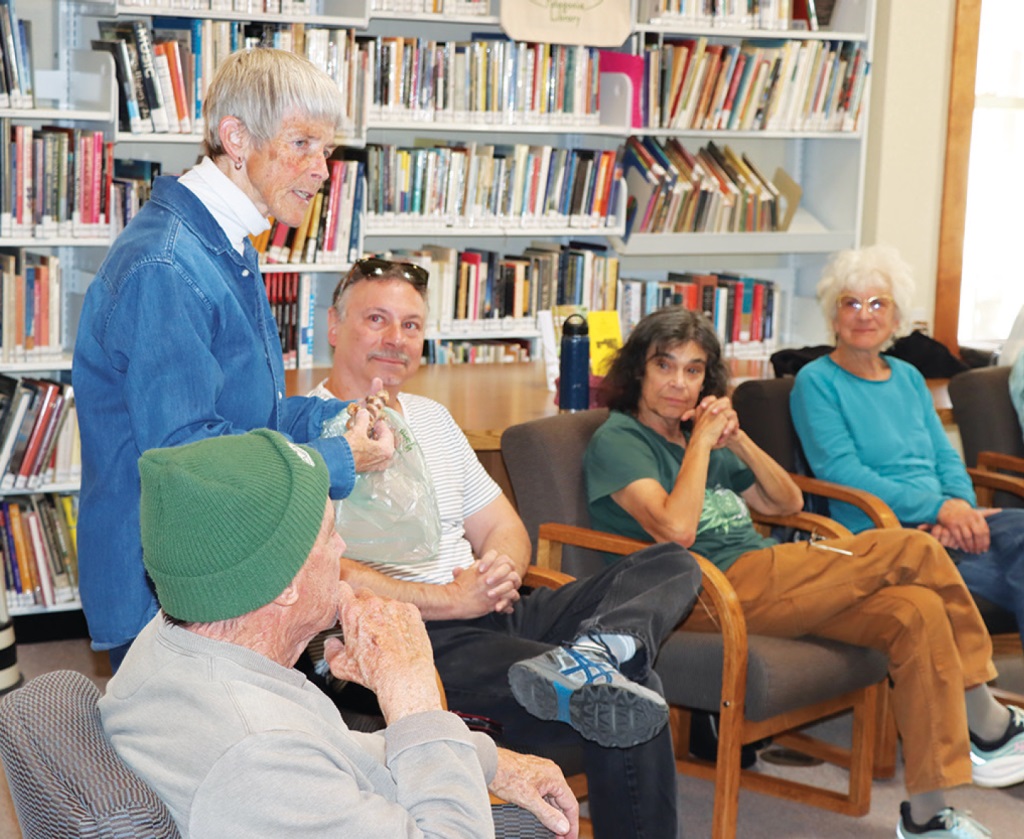
Last month, a standing-room-only group filled the Patagonia Public Library to listen to longtime locals share their stories about growing up in Patagonia and the surrounding areas, when the region was a much different place from the one we know today. The Mexican border was four strands of barbed wire, and the train ran through the center of town. Muddy corrals served as collection points for cattle being loaded and sent to market in Tombstone. The Patagonia Hotel, constructed in the early 1900s by John Cady, lacked running water and served as a home to one of the speakers.
This was the second in this series of “Living Treasures” oral history events sponsored by the Patagonia Public Library. According to library assistant Jade DeForest, who suggested the idea to the library, plans are underway for a third session in February or March.
During this second installment, stories ranged from growing up with horses, goats, and ponies to attending elementary schools in the Lochiel and Harshaw areas until the buses took them to Patagonia High School in eighth grade. And there was some discussion as to which family had the first TV in town. What was agreed upon was how very tall the TV antennas had to be.
Joe Quiroga started the session by noting he was born in 1937 and lived his early years right near where the speakers were gathered. He pointed to the rooms beyond the library desk and said, “I lived right back there until we moved across the street to the Duquesne House. Spent my growing up years all around here… My uncle lived in the last room back there, and he grew a good vegetable garden in the back.”
Quiroga graduated from Patagonia High School, worked a while on the first stretch of Highway 83 around Gardner Canyon before working on local ranches. He was married in 1957 to Noemi. Three of their children were delivered by Doc Mock—a name that reappeared regularly in the stories of the afternoon.
Quiroga started ranch work by tending livestock and training horses. At the same time, both he and his wife drove school buses for years. Joe eventually retired as ranch manager after working 40 years for the Diamond C Ranch in Canelo. He said he was most proud of his work over the years with reclamation of degraded land by clearing invasive mesquites and building dams with local bamboo and wood from the mesquites. The dams collected rain water and allowed native species to return.
Ophelia De La Ossa Spence, born in 1940 in Lochiel, had equally compelling stories of growing up and attending school in Lochiel and Washington Camp. She had memories of walking to grade school about two miles with her two brothers and a sister.
She started taking the bus 20 miles to Patagonia School in the eighth grade. She assured the group that if you misbehaved too much, “they would throw you off the bus. I know because they did [that] to my little brother once!”
Ophelia liked school, especially math and credited her lifelong interest in sewing to the classes she took there. She also loved playing volleyball which was a school favorite. “I think we were the champions two or three times,” she recalled.
Ophelia graduated with a class of 14, eventually married at 22 and moved away with her husband for about 42 years. She always visited and stayed close to her family, even while living out of state. Years later, after her husband died, she moved back from Nevada when her mom was 98.
Her mom survived until she was 103. Ophelia now lives in Green Valley.
Bob Bergier’s roots were deep as well, even though he was born in Florence, Arizona at the end of World War II. When his dad was drafted his mom moved back to town when he was only a few months old. He lays claim to being a fourth generation Patagonian. Both sets of grandparents lived in the area since around 1900, and his dad was born in town on Pennsylvania Avenue. His family moved back to town in 1951, after the death of his grandfather Bergier. Bob attended school here first grade through high school.
“In 1951 we moved into a real old funky house on Pennsylvania Avenue,” Bergier told the crowd. “My dad tore it down and built a new house…Behind our house there was a jungle-like area and there was all this lumber and carpentry left over from the house…and the Patagonia fire engine was parked there and we would play on that. We had a great time.”
Bergier also had tales of a carnival coming to town. He arranged to buy a local chicken to feed to a python that was with the traveling group. He delivered the chicken on his bike but didn’t wait to see it get devoured.
Bergier earned a B.S. in Art at Northern Arizona University and returned to run the family ranch, following a bit of time in the Army. Since 1976, Bergier and his wife Gayle have worked on the family ranch that in the 1920’s his dad had dubbed “Hard Luck.” Bergier is an accomplished artist whose work often depicts regional scenes and captures the spirit of the area.
Patti Holbrook Oliver, who grew up on a ranch south of town on Harshaw, shared lively tales of filling her time riding horses, because she had neither radio or TV. She became a bit of an escape artist, stealing away from home at night to go visit the neighbors and sneaking out with a friend during a school sleep over through a passageway under the Patagonia High School stage.
She only attended junior high school and one year of high school in town. Her folks eventually sent her off to boarding school in Florida, where she made a connection with Cuban students and took a vacation to Cuba.
During the heyday of filming movies here in Santa Cruz County, Oliver was spotted by a casting director during the making of “Oklahoma” and ended up appearing in seven western movies with the likes of John Wayne and Harrison Ford. Her daughter shared a list of the films with the audience.
Arnulfo (Arnie) De La Ossa was born in Lochiel in 1938 and moved to a house between Lochiel and Washington Camp. His brother had a goat, and he rode a pony all over the hills until he was about 10. “The pony finally got it in for me, and I thought he was going to kick me to death,” he recalled, “so I graduated to a horse.”
Arnie’s tales of summer were filled with sharp contrasts to the typical summers now. The rains were regular, the creeks ran high, and the grass grew thick in his memory. He said. “I grew up cowboying with my family… We took our shoes off in May and kept them off all summer, at least until the 4th of July.”
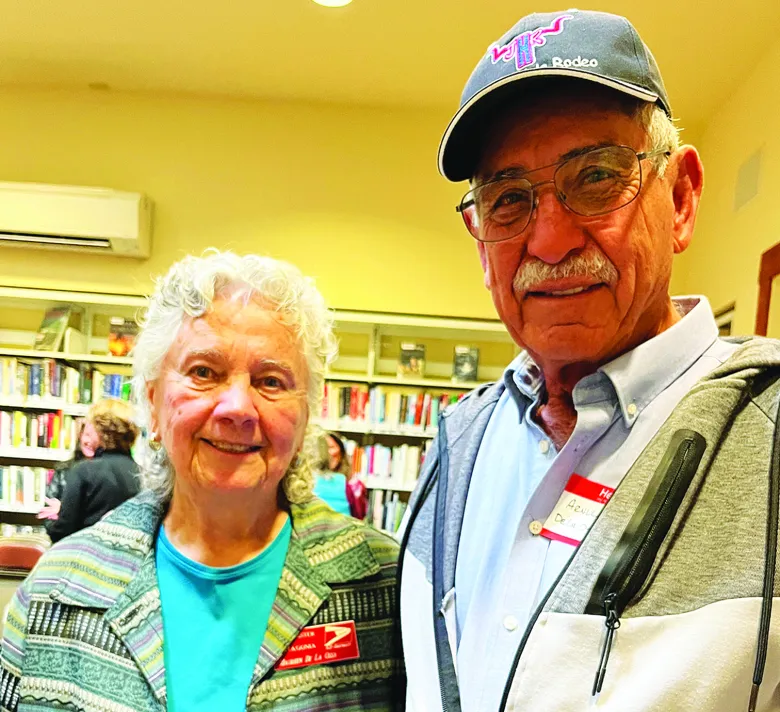
Abel De La Ossa, Arnie’s father, had about 50-60 head of cattle, so they would separate 5-6 good milking cows out for the three boys to tend during the summers. His mother Armida made “real original” quesadillas, a soft cheese. Around noon every day, the boys would deliver small rounds of quesadilla wrapped in waxed paper to the miners.
“There were lots of mines back then,” he remembered. “We would go to the mines around noon and sell packages to the miners for ten cents each.” On the way home, they would stop at a local store for a soda or piece of candy.
After Arnie graduated from Patagonia High School, he served in the Navy SeaBees, which led to his building knowledge. He was assigned to the construction brigade. After he returned to the area in 1960, he married a local, Marsha Beach, and began working at the Vaca Ranch.
Eventually he left the county for a job in 1964 with Arizona Department of Transportation (ADOT) in Tucson, but the ties to home remained strong. Marsha was able to fulfill her dream of going to college and becoming a teacher. He worked for ADOT as an employee and consultant for a total of 50 years, but the trips back to his roots and family were a constant.
Among those attending the Dec. 6 “Living Treasures” event was Cami Schlappy, historian at the Boman-Stradling History Center in Sonoita, along with her family. She was impressed.
“I brought my daughter so she can see that working on horses, walking to school, and spending the summer barefoot really wasn’t that long ago,” Schlappy noted. “I wanted her to see the people who cowboyed the ranches, worked the mines, and lived in now abandoned places. I hope it gives her a new perspective and understanding about our shared community and the people in it.”
Library assistant DeForest was inspired to propose the gatherings by work she had done before she arrived in Patagonia.
“I had a clinic in northern New Mexico and I got to know so many of the people who were many generations there,” she explained “A lot of them were elderly and dying and I thought we needed to hear their stories. So I set a date at my clinic and so many people showed up that we couldn’t get them all in.
We did it four times actually. I believe in the power of oral histories, and so I wanted to bring that experience here to Patagonia.”
DeForest has been pleasantly surprised at the great turnout and audience response to the events here.
The richness of the participants’ stories was surpassed only by the apparent ties the group had to their shared history and their enduring love and appreciation of the area. During the question and answer period, someone asked how many in the crowd were related in some way to one of the speakers. At least a third of the audience raised their hands.
Video recordings of both “Living Treasures” events are available at the Patagonia Public Library’s YouTube channel: youtube.com/@patagoniapubliclibrary3528
Check It Out at the Library: Photographer Edward S. Curtis
Reprinted by permission of the Patagonia Regional Times. Sarah Klingenstein, author
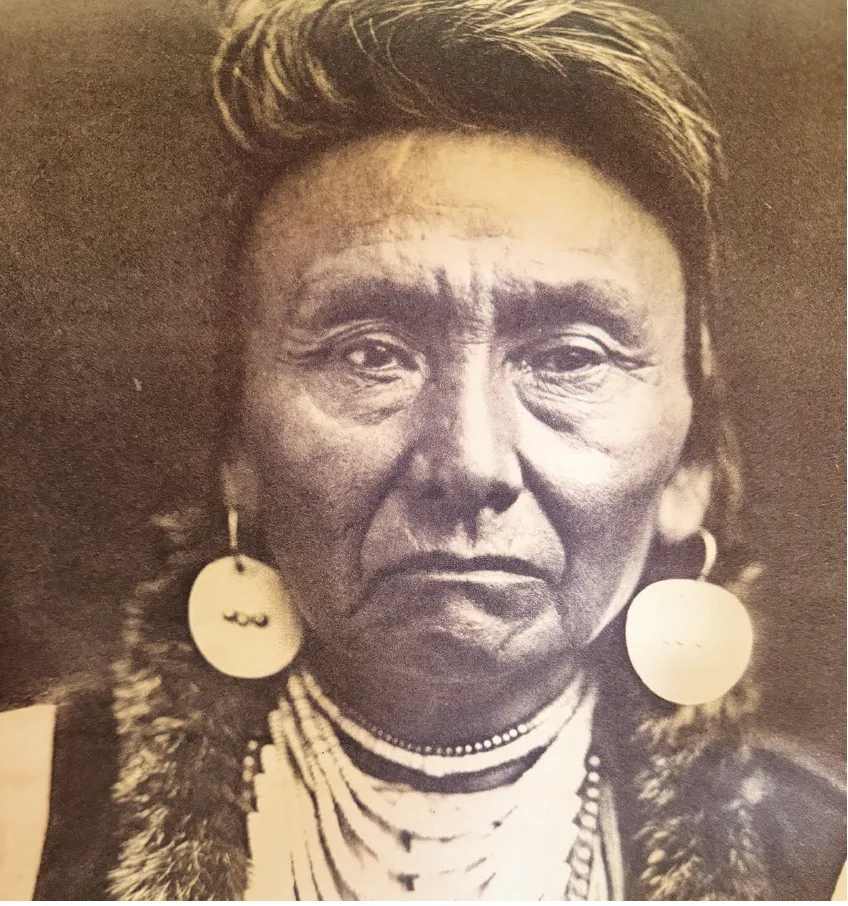
A new Patagonia Library exhibit highlights American photographer Edward S. Curtis, whose 20-volume set of plates and narrative on the Native Americans was lauded in the 1910s, but then languished in rare book rooms and the publisher’s basement until their discovery in 1972.
One of the four fantastic Curtis books the library has on display—and the only one not available for checkout—is “Portraits from North American Indian Life,” measuring 18 by 14.5 inches and containing over 80 large images on heavy paper. These portraits and “slice of life” photos are a rich look into the world Curtis captured for posterity.
One of the two biographies in the collection, “Short Nights of the Shadow Catcher” by Timothy Egan, fleshes out the details of Curtis’s life and exciting work.
Curtis’s first attempt at memorializing native peoples was his 1895 photograph of the daughter of Chief Sealth of Seattle. Moved by a fervent desire to chronicle traditional Native American life before its certain disappearance, over the next 30 years Curtis spent months at a time away from his wife and children as he studied, befriended and photographed tribal peoples from the Nunivak of Alaska to the Hopi of New Mexico. Although much of his research was funded by financier J.P. Morgan, Curtis died in 1952 with his work largely unknown.
As Library Clerk Anne Vogt observed, “When you see a portrait that shows such intimacy, you know the photographer or painter has spent the time and earned the trust of their subject.” That couldn’t be truer than in the case of Edward Curtis. Come check out this gorgeous display, and take one of the books home with you
Running With The Big Dogs
Reprinted by permission of the Patagonia Regional Times. Mary Tolena, author
“People want to hear from you!” was Patagonia Public Library Assistant Jade DeForest’s answer when author Phil Caputo asked why she was inviting him to speak at the library at the end of March. “It’s a stressful time. We want to hear from each other, and especially from people like you.”
Indeed, DeForest was correct: Cady Hall was full, with over 90 listeners eager to hear Caputo’s words and wisdom.
“I am gratified as well as amazed at how many people showed up,” Caputo said. “By the way, this is my favorite town in the whole world!”
That’s saying a lot, considering that Caputo has traveled to 58 countries throughout his long career as an international journalist and author. His 18 novels and non-fiction books include “The Longest Road: Overland in Search of America from Key West to the Arctic Ocean,” about an epic road trip that covered 17,000 miles in four months. In other words, the guy has been places!
Caputo grew up in the western suburbs of Chicago, and got his start in journalism in 1968 as a reporter for the Chicago Tribune, after a 16-month tour of duty in Vietnam. Four years later, he became a foreign correspondent for the Tribune, covering Rome, Moscow, the fall of Saigon, and the Lebanese civil war. He left journalism to focus on writing books in 1977 after being seriously injured in the Beirut conflict zone (see below).
When asked by an audience member, “How did you get to Patagonia?” Caputo credited his close friend and fellow author, the late Jim Harrison, whom Caputo knew from their bird hunting days in Michigan. Jim and his wife Linda had been wintering in Patagonia for several years and they invited Phil and his wife Leslie to visit in 1998. “The Town of Patagonia is unusual,” Harrison told them. “Not your typical Mayberry.”
Leslie and Phil found that to be true—and made an almost immediate decision to make Patagonia their winter home, too.
Harrison and Caputo remained close friends, sharing hunting trips and drinks at the Wagon Wheel until Harrison’s death in 2016. “Being friends with Jim was something of a job,” Caputo said. He recounted one of their adventures in his article “One Night in the Canyon” in the PRT shortly after Jim’s passing.
At the Library Author Talk, Caputo (now age 84) said, “in advancing age, one wonders if one’s life has added up to anything.” The talk encompassed his thoughts on that question, with reflections on three incidents in his career.
The first was about capturing his first scoop as a cub reporter for the Chicago Tribune. It involved overcoming his fear of heights to scramble the 200-foot-high fire escape and catwalks of the prestigious Palmer House Hotel to circumvent the police blockade of the hotel room where a murder had taken place. Caputo reached the window, saw the whole scene, and quickly wrote up the gory details for the paper’s next edition.
Determined to show that he could do whatever it took to get the story first, he knew he also had to fiercely protect his scoop. And so the poor competing journalist who had caught on to what Caputo had done found himself locked in the hotel’s phone room until after his paper’s deadline. “I had proved that I could run with the big dogs,” Caputo said.
A few years later, Caputo said, “I was a Big Dog” as a foreign correspondent in the Tribune’s Middle East bureau during the Lebanese civil war. In the conflict between Christians and the Palestine Liberation Organization, Caputo saw the “worst kind of fighting between people,” and developed a kind of “emotional flak jacket” to deal with the trauma happening around him.
Caputo’s second life reflection was about a particularly gruesome incident where a rocket landed nearby and killed 13 women who were standing in line to buy bread. At the time, Caputo had to compartmentalize their fates as “collateral damage” as he pursued news about the war’s power players and their strategies.
The third incident came four months later, when Caputo was assigned to cover a new phase of the war. To him and his fellow correspondents, it was basically a suicide mission into high-conflict territory.
Sure enough, they were stopped by Muslim militants. After a disagreement about their press cards, they were let go, but were followed by two gunmen. As they ran zigging and zagging, Caputo was hit by shrapnel, then by a bullet that shattered his ankle.
Luckily, Caputo had fallen in a Christian-held street, where he crawled into a building and miraculously found a vascular surgeon taking shelter there. He eventually reached a hospital in the middle of the war zone, where he was treated with no anesthesia. The pain was like nothing he’d ever felt before or since.
Eventually, he was evacuated back to his parents’ house in the same Chicago suburb he’d been so eager to leave as a young adult. During his rehab time, as he progressed from wheelchair, to crutches, to a cane, Caputo wrestled with the big question of Why? Why was I shot? Why did this happen to me?
He eventually realized that it was up to him to supply the answers, and in fact “Why?” was not the important question. “What was important was what I made of it,” Caputo said.
One thing he made of it was his first book, his best-selling Vietnam memoir, “Rumors of War.” He got the book contract and finished the manuscript in nine months while recovering.
Reflecting further on his traumatic incident, Caputo said that having to wrestle with loss, injury and anguish can call forth the best in us, too. He recalled the 13 women in the breadline, whom he had “callously dismissed as collateral damage.”
“I concluded that I had been wounded to know what suffering really meant,” Caputo said. “I had been meant to relearn compassion.”
Caputo is now working on another book, a collection of short stories called “Wandering Souls,” which will be published in late 2025 or early 2026. His other books are available at the Patagonia Library, and are described on his website, PhilipCaputo.com, along with his “Dispatches”of current political commentary.
Relive Phil’s talk on the Library’s YouTube channel.
New Club Finds Health in the Spices of Life
Reprinted by permission of the Patagonia Regional Times
Fifty free turmeric samples.
That’s what Jade DeForest prepared in launching of The Spice Club, an herbalicious group recently formed through the Patagonia Public Library.
Turns out DeForest underestimated interest. Back into the kitchen she skedaddled to make 50 more sacks.
“I really did not expect the response,” DeForest said. A Sonoita resident and Patagonia Library employee, DeForest ran with a suggestion given to her by Summer Smith, former library administrator.
And—snap—the idea seems to have taken off with the community: Free spice samples given out monthly, with a meeting to share recipes and ideas (held at 2 p.m. on the third Friday of the month at the library).
That this was an easy suggestion for DeForest to embrace is a given. No stranger to the concept of “food as medicine,” DeForest served as an herbal pharmacist in Ojo Caliente, N.M. Now she’s delighting local residents with her expertise on a subject she is passionate about.
“All spices have medicinal qualities,” she said. Turmeric is a powerful example of that, as it is used in both Chinese and Indian systems as an anti-inflammatory and treatment for Irritable Bowel Syndrome, among other things.
But turmeric is just the start of this culinary and medicinal adventure. In March the focus will be ginger. After that, who knows—lobelia, used for asthma and depression; chaparral, assisting with arthritis and the common cold; white willow bark, which helps with pain and inflammation; and dill, assisting with flatulence and digestive disturbances.
“Our ancestors found medicinal uses for herbs as early as 3,000 BC,” said food writer Beth Dooley who co-authored the book Chile, Clove, and Cardamom with Patagonia scholar Gary Paul Nabhan. “Ginger, turmeric, garlic, juniper and elderberries were used as treatments for a number of conditions, brewed into teas for respiratory conditions, pounded into [poultices] for wounds, burns and sores.”
Ginger, the Spice Club’s focus in March, is a favorite of Dooley’s. “I’m a huge fan of ginger for its warming properties—brewing it into teas, adding it to stir fries, soups and stews. It, too, is known to contain potent anti-inflammatory properties, support digestion, balance blood sugar and support heart health.”
Now the million-dollar question: heath-wise, which is better—fresh or dried?
According to the website superfoodly, dried herbs have higher antioxidant concentrations than fresh. This is because fresh are largely water. Fresh herbs, too, need to be used promptly. As for dried, varieties should be stored in a dark cool location to maintain their flavor and potency.
Hot off the Press…
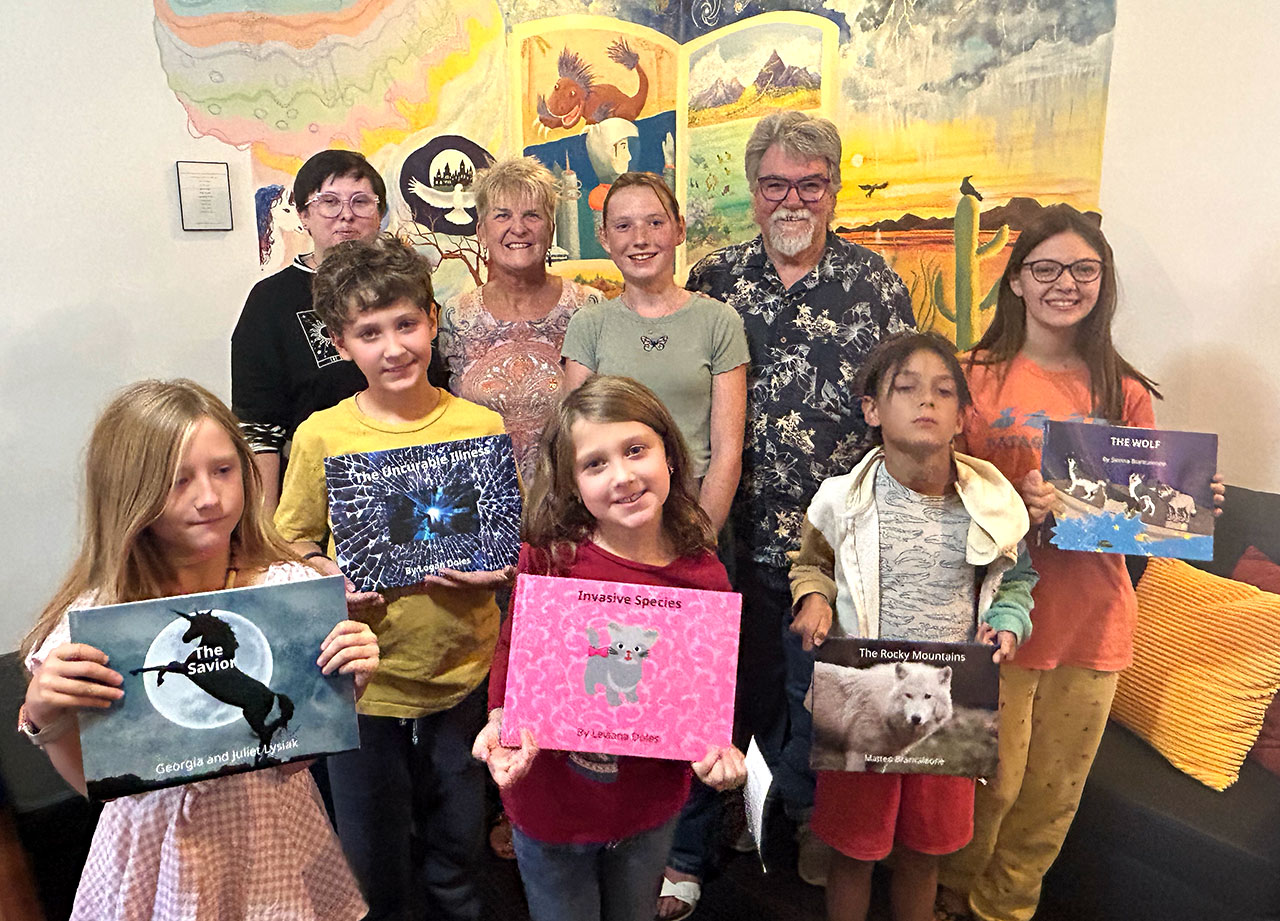
There is nothing we love more than inviting local authors to read their creations to our patrons. During the recent opening of the revamped Teen Room, we were lucky enough to have four of the six recent graduates of the Universe Within STEAM World Building program join us to read excerpts from their novels. They entertained us with tales of superhero characters who solve major social or environmental problems in their worlds.
And the great news is all these books are now available for checkout at the Library!! You too can be inspired by the world the youth of our community envision.
Click here for more information about the fabulous Universe Within program, designed and offered at no charge by the Mat Bevel Company.
Grand Re-Opening of the Teen Room
The long-awaited grand opening of the revamped Teen Room was held on Saturday, October 19th and was attended by many who had a hand in creating this fun and comfortable space. The backstory is that former library director Kayla Miller had a desire to create a space for the youth of this community that would foster and encourage literacy in a comfortable and safe space. She noticed reading and reading comprehension was a struggle for some teens in town and wanted to be a part of helping them embrace literacy. Ms. Miller applied for a grant through the Library Services and Technology Act Fund and was awarded $10,000.00 in late 2023. Furniture, Laptops, games, books, art supplies, software, and an iPad were purchased to enhance this space.
When Linda Shore, chairman of the Library Advisory Board, heard of Ms. Miller’s teen room makeover she wanted to help. Kayla shared her vision of wanting to have a mural painted on the wall that added color and life to the room which led to Ryan, Linda and Tom Shore graciously donating the money to purchase the art supplies. Local artist Jacqui Treinen helped orchestrate this beautiful endeavor. Jacqui, along with 8 other artists brought the unique work of art to life. This mural, entitled “Books Open Up New Worlds” has been dedicated in loving memory of Sam Shore (1979-2024).
The library staff would like to thank all the artists who contributed to this masterpiece, Jacqui Treinen, David Krest, Gisa Kruegar, Kayla Miller, Benjamin Krzys, Andrew Botz, Thomas Botz, Lily Harsh and Sally Warren. We also send a big thank you to Kayla Miller for her vision and dedication to this project that will benefit the youth in our community.
The Way It Was
Reprinted by permission of the Patagonia Regional Times. Sondra Porter, author
Last month, a standing-room-only group filled the Patagonia Public Library to listen to longtime locals share their stories about growing up in Patagonia and the surrounding areas, when the region was a much different place from the one we know today. The Mexican border was four strands of barbed wire, and the train ran through the center of town. Muddy corrals served as collection points for cattle being loaded and sent to market in Tombstone. The Patagonia Hotel, constructed in the early 1900s by John Cady, lacked running water and served as a home to one of the speakers.
This was the second in this series of “Living Treasures” oral history events sponsored by the Patagonia Public Library. According to library assistant Jade DeForest, who suggested the idea to the library, plans are underway for a third session in February or March.
During this second installment, stories ranged from growing up with horses, goats, and ponies to attending elementary schools in the Lochiel and Harshaw areas until the buses took them to Patagonia High School in eighth grade. And there was some discussion as to which family had the first TV in town. What was agreed upon was how very tall the TV antennas had to be.
Joe Quiroga started the session by noting he was born in 1937 and lived his early years right near where the speakers were gathered. He pointed to the rooms beyond the library desk and said, “I lived right back there until we moved across the street to the Duquesne House. Spent my growing up years all around here… My uncle lived in the last room back there, and he grew a good vegetable garden in the back.”
Quiroga graduated from Patagonia High School, worked a while on the first stretch of Highway 83 around Gardner Canyon before working on local ranches. He was married in 1957 to Noemi. Three of their children were delivered by Doc Mock—a name that reappeared regularly in the stories of the afternoon.
Quiroga started ranch work by tending livestock and training horses. At the same time, both he and his wife drove school buses for years. Joe eventually retired as ranch manager after working 40 years for the Diamond C Ranch in Canelo. He said he was most proud of his work over the years with reclamation of degraded land by clearing invasive mesquites and building dams with local bamboo and wood from the mesquites. The dams collected rain water and allowed native species to return.
Ophelia De La Ossa Spence, born in 1940 in Lochiel, had equally compelling stories of growing up and attending school in Lochiel and Washington Camp. She had memories of walking to grade school about two miles with her two brothers and a sister.
She started taking the bus 20 miles to Patagonia School in the eighth grade. She assured the group that if you misbehaved too much, “they would throw you off the bus. I know because they did [that] to my little brother once!”
Ophelia liked school, especially math and credited her lifelong interest in sewing to the classes she took there. She also loved playing volleyball which was a school favorite. “I think we were the champions two or three times,” she recalled.
Ophelia graduated with a class of 14, eventually married at 22 and moved away with her husband for about 42 years. She always visited and stayed close to her family, even while living out of state. Years later, after her husband died, she moved back from Nevada when her mom was 98.
Her mom survived until she was 103. Ophelia now lives in Green Valley.
Bob Bergier’s roots were deep as well, even though he was born in Florence, Arizona at the end of World War II. When his dad was drafted his mom moved back to town when he was only a few months old. He lays claim to being a fourth generation Patagonian. Both sets of grandparents lived in the area since around 1900, and his dad was born in town on Pennsylvania Avenue. His family moved back to town in 1951, after the death of his grandfather Bergier. Bob attended school here first grade through high school.
“In 1951 we moved into a real old funky house on Pennsylvania Avenue,” Bergier told the crowd. “My dad tore it down and built a new house…Behind our house there was a jungle-like area and there was all this lumber and carpentry left over from the house…and the Patagonia fire engine was parked there and we would play on that. We had a great time.”
Bergier also had tales of a carnival coming to town. He arranged to buy a local chicken to feed to a python that was with the traveling group. He delivered the chicken on his bike but didn’t wait to see it get devoured.
Bergier earned a B.S. in Art at Northern Arizona University and returned to run the family ranch, following a bit of time in the Army. Since 1976, Bergier and his wife Gayle have worked on the family ranch that in the 1920’s his dad had dubbed “Hard Luck.” Bergier is an accomplished artist whose work often depicts regional scenes and captures the spirit of the area.
Patti Holbrook Oliver, who grew up on a ranch south of town on Harshaw, shared lively tales of filling her time riding horses, because she had neither radio or TV. She became a bit of an escape artist, stealing away from home at night to go visit the neighbors and sneaking out with a friend during a school sleep over through a passageway under the Patagonia High School stage.
She only attended junior high school and one year of high school in town. Her folks eventually sent her off to boarding school in Florida, where she made a connection with Cuban students and took a vacation to Cuba.
During the heyday of filming movies here in Santa Cruz County, Oliver was spotted by a casting director during the making of “Oklahoma” and ended up appearing in seven western movies with the likes of John Wayne and Harrison Ford. Her daughter shared a list of the films with the audience.
Arnulfo (Arnie) De La Ossa was born in Lochiel in 1938 and moved to a house between Lochiel and Washington Camp. His brother had a goat, and he rode a pony all over the hills until he was about 10. “The pony finally got it in for me, and I thought he was going to kick me to death,” he recalled, “so I graduated to a horse.”
Arnie’s tales of summer were filled with sharp contrasts to the typical summers now. The rains were regular, the creeks ran high, and the grass grew thick in his memory. He said. “I grew up cowboying with my family… We took our shoes off in May and kept them off all summer, at least until the 4th of July.”
Abel De La Ossa, Arnie’s father, had about 50-60 head of cattle, so they would separate 5-6 good milking cows out for the three boys to tend during the summers. His mother Armida made “real original” quesadillas, a soft cheese. Around noon every day, the boys would deliver small rounds of quesadilla wrapped in waxed paper to the miners.
“There were lots of mines back then,” he remembered. “We would go to the mines around noon and sell packages to the miners for ten cents each.” On the way home, they would stop at a local store for a soda or piece of candy.
After Arnie graduated from Patagonia High School, he served in the Navy SeaBees, which led to his building knowledge. He was assigned to the construction brigade. After he returned to the area in 1960, he married a local, Marsha Beach, and began working at the Vaca Ranch.
Eventually he left the county for a job in 1964 with Arizona Department of Transportation (ADOT) in Tucson, but the ties to home remained strong. Marsha was able to fulfill her dream of going to college and becoming a teacher. He worked for ADOT as an employee and consultant for a total of 50 years, but the trips back to his roots and family were a constant.
Among those attending the Dec. 6 “Living Treasures” event was Cami Schlappy, historian at the Boman-Stradling History Center in Sonoita, along with her family. She was impressed.
“I brought my daughter so she can see that working on horses, walking to school, and spending the summer barefoot really wasn’t that long ago,” Schlappy noted. “I wanted her to see the people who cowboyed the ranches, worked the mines, and lived in now abandoned places. I hope it gives her a new perspective and understanding about our shared community and the people in it.”
Library assistant DeForest was inspired to propose the gatherings by work she had done before she arrived in Patagonia.
“I had a clinic in northern New Mexico and I got to know so many of the people who were many generations there,” she explained “A lot of them were elderly and dying and I thought we needed to hear their stories. So I set a date at my clinic and so many people showed up that we couldn’t get them all in.
We did it four times actually. I believe in the power of oral histories, and so I wanted to bring that experience here to Patagonia.”
DeForest has been pleasantly surprised at the great turnout and audience response to the events here.
The richness of the participants’ stories was surpassed only by the apparent ties the group had to their shared history and their enduring love and appreciation of the area. During the question and answer period, someone asked how many in the crowd were related in some way to one of the speakers. At least a third of the audience raised their hands.
Video recordings of both “Living Treasures” events are available at the Patagonia Public Library’s YouTube channel: youtube.com/@patagoniapubliclibrary3528
Check It Out at the Library: Photographer Edward S. Curtis
Reprinted by permission of the Patagonia Regional Times. Sarah Klingenstein, author
A new Patagonia Library exhibit highlights American photographer Edward S. Curtis, whose 20-volume set of plates and narrative on the Native Americans was lauded in the 1910s, but then languished in rare book rooms and the publisher’s basement until their discovery in 1972.
One of the four fantastic Curtis books the library has on display—and the only one not available for checkout—is “Portraits from North American Indian Life,” measuring 18 by 14.5 inches and containing over 80 large images on heavy paper. These portraits and “slice of life” photos are a rich look into the world Curtis captured for posterity.
One of the two biographies in the collection, “Short Nights of the Shadow Catcher” by Timothy Egan, fleshes out the details of Curtis’s life and exciting work.
Curtis’s first attempt at memorializing native peoples was his 1895 photograph of the daughter of Chief Sealth of Seattle. Moved by a fervent desire to chronicle traditional Native American life before its certain disappearance, over the next 30 years Curtis spent months at a time away from his wife and children as he studied, befriended and photographed tribal peoples from the Nunivak of Alaska to the Hopi of New Mexico. Although much of his research was funded by financier J.P. Morgan, Curtis died in 1952 with his work largely unknown.
As Library Clerk Anne Vogt observed, “When you see a portrait that shows such intimacy, you know the photographer or painter has spent the time and earned the trust of their subject.” That couldn’t be truer than in the case of Edward Curtis. Come check out this gorgeous display, and take one of the books home with you
Running With The Big Dogs
Reprinted by permission of the Patagonia Regional Times. Mary Tolena, author
“People want to hear from you!” was Patagonia Public Library Assistant Jade DeForest’s answer when author Phil Caputo asked why she was inviting him to speak at the library at the end of March. “It’s a stressful time. We want to hear from each other, and especially from people like you.”
Indeed, DeForest was correct: Cady Hall was full, with over 90 listeners eager to hear Caputo’s words and wisdom.
“I am gratified as well as amazed at how many people showed up,” Caputo said. “By the way, this is my favorite town in the whole world!”
That’s saying a lot, considering that Caputo has traveled to 58 countries throughout his long career as an international journalist and author. His 18 novels and non-fiction books include “The Longest Road: Overland in Search of America from Key West to the Arctic Ocean,” about an epic road trip that covered 17,000 miles in four months. In other words, the guy has been places!
Caputo grew up in the western suburbs of Chicago, and got his start in journalism in 1968 as a reporter for the Chicago Tribune, after a 16-month tour of duty in Vietnam. Four years later, he became a foreign correspondent for the Tribune, covering Rome, Moscow, the fall of Saigon, and the Lebanese civil war. He left journalism to focus on writing books in 1977 after being seriously injured in the Beirut conflict zone (see below).
When asked by an audience member, “How did you get to Patagonia?” Caputo credited his close friend and fellow author, the late Jim Harrison, whom Caputo knew from their bird hunting days in Michigan. Jim and his wife Linda had been wintering in Patagonia for several years and they invited Phil and his wife Leslie to visit in 1998. “The Town of Patagonia is unusual,” Harrison told them. “Not your typical Mayberry.”
Leslie and Phil found that to be true—and made an almost immediate decision to make Patagonia their winter home, too.
Harrison and Caputo remained close friends, sharing hunting trips and drinks at the Wagon Wheel until Harrison’s death in 2016. “Being friends with Jim was something of a job,” Caputo said. He recounted one of their adventures in his article “One Night in the Canyon” in the PRT shortly after Jim’s passing.
At the Library Author Talk, Caputo (now age 84) said, “in advancing age, one wonders if one’s life has added up to anything.” The talk encompassed his thoughts on that question, with reflections on three incidents in his career.
The first was about capturing his first scoop as a cub reporter for the Chicago Tribune. It involved overcoming his fear of heights to scramble the 200-foot-high fire escape and catwalks of the prestigious Palmer House Hotel to circumvent the police blockade of the hotel room where a murder had taken place. Caputo reached the window, saw the whole scene, and quickly wrote up the gory details for the paper’s next edition.
Determined to show that he could do whatever it took to get the story first, he knew he also had to fiercely protect his scoop. And so the poor competing journalist who had caught on to what Caputo had done found himself locked in the hotel’s phone room until after his paper’s deadline. “I had proved that I could run with the big dogs,” Caputo said.
A few years later, Caputo said, “I was a Big Dog” as a foreign correspondent in the Tribune’s Middle East bureau during the Lebanese civil war. In the conflict between Christians and the Palestine Liberation Organization, Caputo saw the “worst kind of fighting between people,” and developed a kind of “emotional flak jacket” to deal with the trauma happening around him.
Caputo’s second life reflection was about a particularly gruesome incident where a rocket landed nearby and killed 13 women who were standing in line to buy bread. At the time, Caputo had to compartmentalize their fates as “collateral damage” as he pursued news about the war’s power players and their strategies.
The third incident came four months later, when Caputo was assigned to cover a new phase of the war. To him and his fellow correspondents, it was basically a suicide mission into high-conflict territory.
Sure enough, they were stopped by Muslim militants. After a disagreement about their press cards, they were let go, but were followed by two gunmen. As they ran zigging and zagging, Caputo was hit by shrapnel, then by a bullet that shattered his ankle.
Luckily, Caputo had fallen in a Christian-held street, where he crawled into a building and miraculously found a vascular surgeon taking shelter there. He eventually reached a hospital in the middle of the war zone, where he was treated with no anesthesia. The pain was like nothing he’d ever felt before or since.
Eventually, he was evacuated back to his parents’ house in the same Chicago suburb he’d been so eager to leave as a young adult. During his rehab time, as he progressed from wheelchair, to crutches, to a cane, Caputo wrestled with the big question of Why? Why was I shot? Why did this happen to me?
He eventually realized that it was up to him to supply the answers, and in fact “Why?” was not the important question. “What was important was what I made of it,” Caputo said.
One thing he made of it was his first book, his best-selling Vietnam memoir, “Rumors of War.” He got the book contract and finished the manuscript in nine months while recovering.
Reflecting further on his traumatic incident, Caputo said that having to wrestle with loss, injury and anguish can call forth the best in us, too. He recalled the 13 women in the breadline, whom he had “callously dismissed as collateral damage.”
“I concluded that I had been wounded to know what suffering really meant,” Caputo said. “I had been meant to relearn compassion.”
Caputo is now working on another book, a collection of short stories called “Wandering Souls,” which will be published in late 2025 or early 2026. His other books are available at the Patagonia Library, and are described on his website, PhilipCaputo.com, along with his “Dispatches”of current political commentary.
Relive Phil’s talk on the Library’s YouTube channel.
New Club Finds Health in the Spices of Life
Reprinted by permission of the Patagonia Regional Times
Fifty free turmeric samples.
That’s what Jade DeForest prepared in launching of The Spice Club, an herbalicious group recently formed through the Patagonia Public Library.
Turns out DeForest underestimated interest. Back into the kitchen she skedaddled to make 50 more sacks.
“I really did not expect the response,” DeForest said. A Sonoita resident and Patagonia Library employee, DeForest ran with a suggestion given to her by Summer Smith, former library administrator.
And—snap—the idea seems to have taken off with the community: Free spice samples given out monthly, with a meeting to share recipes and ideas (held at 2 p.m. on the third Friday of the month at the library).
That this was an easy suggestion for DeForest to embrace is a given. No stranger to the concept of “food as medicine,” DeForest served as an herbal pharmacist in Ojo Caliente, N.M. Now she’s delighting local residents with her expertise on a subject she is passionate about.
“All spices have medicinal qualities,” she said. Turmeric is a powerful example of that, as it is used in both Chinese and Indian systems as an anti-inflammatory and treatment for Irritable Bowel Syndrome, among other things.
But turmeric is just the start of this culinary and medicinal adventure. In March the focus will be ginger. After that, who knows—lobelia, used for asthma and depression; chaparral, assisting with arthritis and the common cold; white willow bark, which helps with pain and inflammation; and dill, assisting with flatulence and digestive disturbances.
“Our ancestors found medicinal uses for herbs as early as 3,000 BC,” said food writer Beth Dooley who co-authored the book Chile, Clove, and Cardamom with Patagonia scholar Gary Paul Nabhan. “Ginger, turmeric, garlic, juniper and elderberries were used as treatments for a number of conditions, brewed into teas for respiratory conditions, pounded into [poultices] for wounds, burns and sores.”
Ginger, the Spice Club’s focus in March, is a favorite of Dooley’s. “I’m a huge fan of ginger for its warming properties—brewing it into teas, adding it to stir fries, soups and stews. It, too, is known to contain potent anti-inflammatory properties, support digestion, balance blood sugar and support heart health.”
Now the million-dollar question: heath-wise, which is better—fresh or dried?
According to the website superfoodly, dried herbs have higher antioxidant concentrations than fresh. This is because fresh are largely water. Fresh herbs, too, need to be used promptly. As for dried, varieties should be stored in a dark cool location to maintain their flavor and potency.
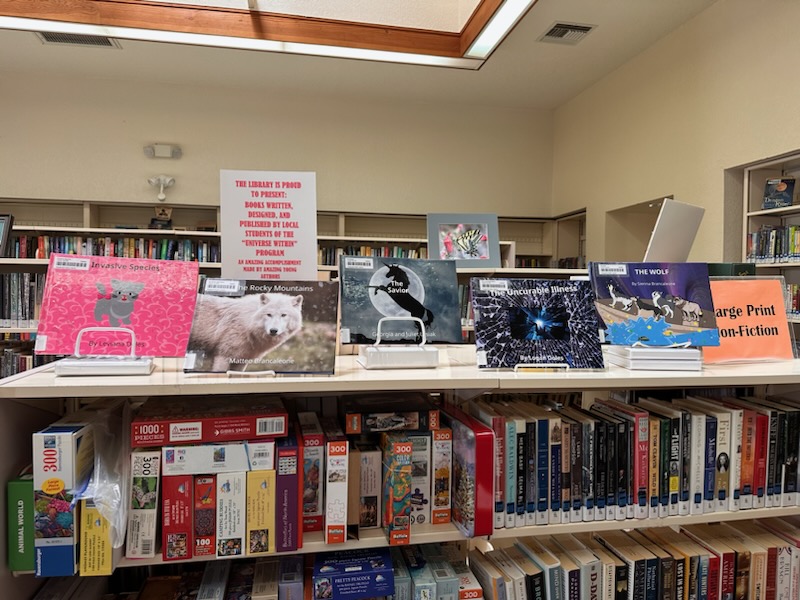
Hot off the Press…
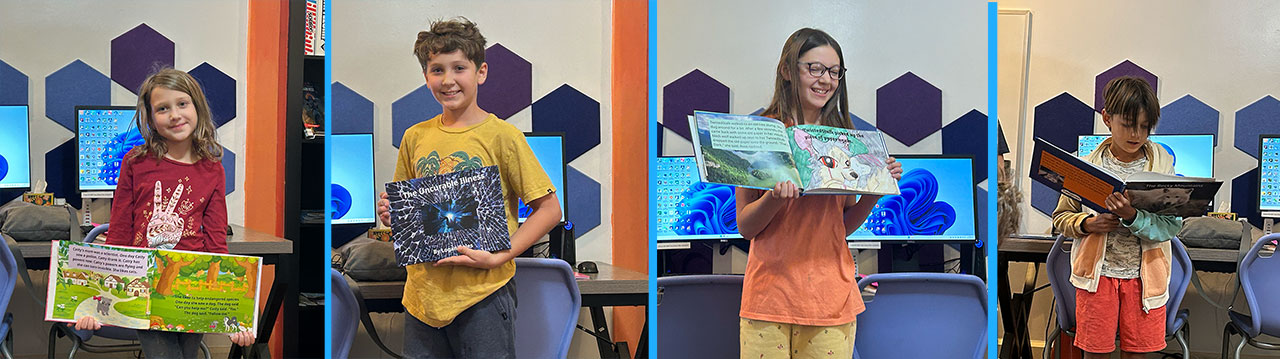
There is nothing we love more than inviting local authors to read their creations to our patrons. During the recent opening of the revamped Teen Room, we were lucky enough to have four of the six recent graduates of the Universe Within STEAM World Building program join us to read excerpts from their novels. They entertained us with tales of superhero characters who solve major social or environmental problems in their worlds.
And the great news is all these books are now available for checkout at the Library!! You too can be inspired by the world the youth of our community envision.
Click here for more information about the fabulous Universe Within program, designed and offered at no charge by the Mat Bevel Company.
Grand Re-Opening of the Teen Room
The long-awaited grand opening of the revamped Teen Room was held on Saturday, October 19th and was attended by many who had a hand in creating this fun and comfortable space. The backstory is that former library director Kayla Miller had a desire to create a space for the youth of this community that would foster and encourage literacy in a comfortable and safe space. She noticed reading and reading comprehension was a struggle for some teens in town and wanted to be a part of helping them embrace literacy. Ms. Miller applied for a grant through the Library Services and Technology Act Fund and was awarded $10,000.00 in late 2023. Furniture, Laptops, games, books, art supplies, software, and an iPad were purchased to enhance this space.
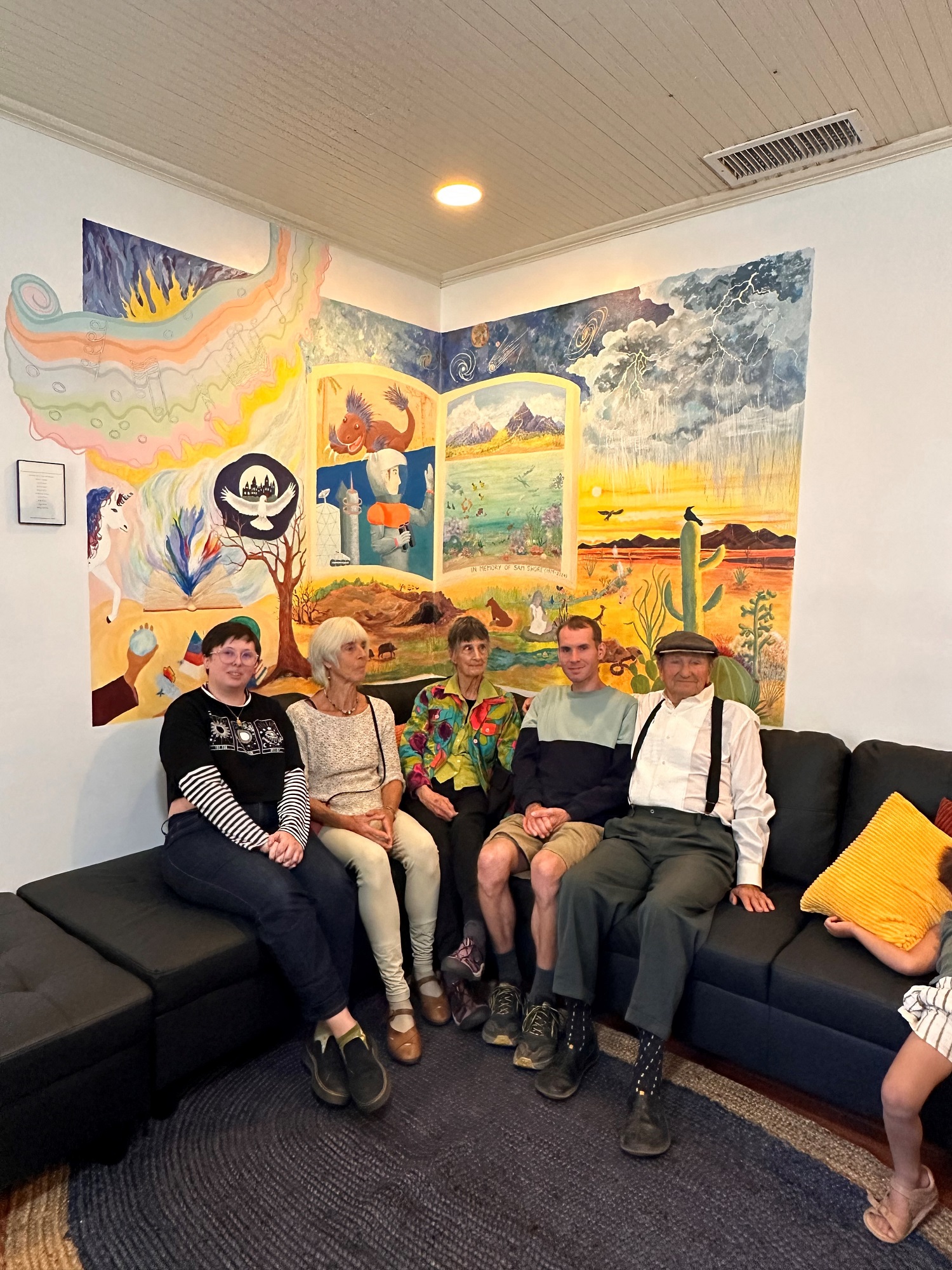
When Linda Shore, chairman of the Library Advisory Board, heard of Ms. Miller’s teen room makeover she wanted to help. Kayla shared her vision of wanting to have a mural painted on the wall that added color and life to the room which led to Ryan, Linda and Tom Shore graciously donating the money to purchase the art supplies. Local artist Jacqui Treinen helped orchestrate this beautiful endeavor. Jacqui, along with 8 other artists brought the unique work of art to life. This mural, entitled “Books Open Up New Worlds” has been dedicated in loving memory of Sam Shore (1979-2024).
The library staff would like to thank all the artists who contributed to this masterpiece, Jacqui Treinen, David Krest, Gisa Kruegar, Kayla Miller, Benjamin Krzys, Andrew Botz, Thomas Botz, Lily Harsh and Sally Warren. We also send a big thank you to Kayla Miller for her vision and dedication to this project that will benefit the youth in our community.
Check It Out at the Library: What’s New
Reprinted by permission of the Patagonia Regional Times. Written by the Library Team
Looking for something to read to welcome in the new year? We just received a shipment of highly acclaimed bestsellers including:
“Silent Bones” by Val McDermid
“The Librarians” by Sherry Thomas
“Woman in Suite 11” by Ruth Ware
“The Red Queen” by Martha Grimes
“Will-O-The Wisp” by Jenna Gillingham
“The Living and the Dead” by Christopher Carlson
“Shaw Connolly Lives to Tell” by Gilliam French
And the eagerly anticipated latest from Craig Johnson, “Return to Sender”.
Rather watch a movie or a TV series instead? We have almost 2,000 titles in our collection so you’re sure to find something to pique your interest.
We hope you drop by next time you’re in the ‘hood to check out the latest additions to our collections.
The Way It Was
Reprinted by permission of the Patagonia Regional Times. Sondra Porter, author
Last month, a standing-room-only group filled the Patagonia Public Library to listen to longtime locals share their stories about growing up in Patagonia and the surrounding areas, when the region was a much different place from the one we know today. The Mexican border was four strands of barbed wire, and the train ran through the center of town. Muddy corrals served as collection points for cattle being loaded and sent to market in Tombstone. The Patagonia Hotel, constructed in the early 1900s by John Cady, lacked running water and served as a home to one of the speakers.
This was the second in this series of “Living Treasures” oral history events sponsored by the Patagonia Public Library. According to library assistant Jade DeForest, who suggested the idea to the library, plans are underway for a third session in February or March.
During this second installment, stories ranged from growing up with horses, goats, and ponies to attending elementary schools in the Lochiel and Harshaw areas until the buses took them to Patagonia High School in eighth grade. And there was some discussion as to which family had the first TV in town. What was agreed upon was how very tall the TV antennas had to be.
Joe Quiroga started the session by noting he was born in 1937 and lived his early years right near where the speakers were gathered. He pointed to the rooms beyond the library desk and said, “I lived right back there until we moved across the street to the Duquesne House. Spent my growing up years all around here… My uncle lived in the last room back there, and he grew a good vegetable garden in the back.”
Quiroga graduated from Patagonia High School, worked a while on the first stretch of Highway 83 around Gardner Canyon before working on local ranches. He was married in 1957 to Noemi. Three of their children were delivered by Doc Mock—a name that reappeared regularly in the stories of the afternoon.
Quiroga started ranch work by tending livestock and training horses. At the same time, both he and his wife drove school buses for years. Joe eventually retired as ranch manager after working 40 years for the Diamond C Ranch in Canelo. He said he was most proud of his work over the years with reclamation of degraded land by clearing invasive mesquites and building dams with local bamboo and wood from the mesquites. The dams collected rain water and allowed native species to return.
Ophelia De La Ossa Spence, born in 1940 in Lochiel, had equally compelling stories of growing up and attending school in Lochiel and Washington Camp. She had memories of walking to grade school about two miles with her two brothers and a sister.
She started taking the bus 20 miles to Patagonia School in the eighth grade. She assured the group that if you misbehaved too much, “they would throw you off the bus. I know because they did [that] to my little brother once!”
Ophelia liked school, especially math and credited her lifelong interest in sewing to the classes she took there. She also loved playing volleyball which was a school favorite. “I think we were the champions two or three times,” she recalled.
Ophelia graduated with a class of 14, eventually married at 22 and moved away with her husband for about 42 years. She always visited and stayed close to her family, even while living out of state. Years later, after her husband died, she moved back from Nevada when her mom was 98.
Her mom survived until she was 103. Ophelia now lives in Green Valley.
Bob Bergier’s roots were deep as well, even though he was born in Florence, Arizona at the end of World War II. When his dad was drafted his mom moved back to town when he was only a few months old. He lays claim to being a fourth generation Patagonian. Both sets of grandparents lived in the area since around 1900, and his dad was born in town on Pennsylvania Avenue. His family moved back to town in 1951, after the death of his grandfather Bergier. Bob attended school here first grade through high school.
“In 1951 we moved into a real old funky house on Pennsylvania Avenue,” Bergier told the crowd. “My dad tore it down and built a new house…Behind our house there was a jungle-like area and there was all this lumber and carpentry left over from the house…and the Patagonia fire engine was parked there and we would play on that. We had a great time.”
Bergier also had tales of a carnival coming to town. He arranged to buy a local chicken to feed to a python that was with the traveling group. He delivered the chicken on his bike but didn’t wait to see it get devoured.
Bergier earned a B.S. in Art at Northern Arizona University and returned to run the family ranch, following a bit of time in the Army. Since 1976, Bergier and his wife Gayle have worked on the family ranch that in the 1920’s his dad had dubbed “Hard Luck.” Bergier is an accomplished artist whose work often depicts regional scenes and captures the spirit of the area.
Patti Holbrook Oliver, who grew up on a ranch south of town on Harshaw, shared lively tales of filling her time riding horses, because she had neither radio or TV. She became a bit of an escape artist, stealing away from home at night to go visit the neighbors and sneaking out with a friend during a school sleep over through a passageway under the Patagonia High School stage.
She only attended junior high school and one year of high school in town. Her folks eventually sent her off to boarding school in Florida, where she made a connection with Cuban students and took a vacation to Cuba.
During the heyday of filming movies here in Santa Cruz County, Oliver was spotted by a casting director during the making of “Oklahoma” and ended up appearing in seven western movies with the likes of John Wayne and Harrison Ford. Her daughter shared a list of the films with the audience.
Arnulfo (Arnie) De La Ossa was born in Lochiel in 1938 and moved to a house between Lochiel and Washington Camp. His brother had a goat, and he rode a pony all over the hills until he was about 10. “The pony finally got it in for me, and I thought he was going to kick me to death,” he recalled, “so I graduated to a horse.”
Arnie’s tales of summer were filled with sharp contrasts to the typical summers now. The rains were regular, the creeks ran high, and the grass grew thick in his memory. He said. “I grew up cowboying with my family… We took our shoes off in May and kept them off all summer, at least until the 4th of July.”
Abel De La Ossa, Arnie’s father, had about 50-60 head of cattle, so they would separate 5-6 good milking cows out for the three boys to tend during the summers. His mother Armida made “real original” quesadillas, a soft cheese. Around noon every day, the boys would deliver small rounds of quesadilla wrapped in waxed paper to the miners.
“There were lots of mines back then,” he remembered. “We would go to the mines around noon and sell packages to the miners for ten cents each.” On the way home, they would stop at a local store for a soda or piece of candy.
After Arnie graduated from Patagonia High School, he served in the Navy SeaBees, which led to his building knowledge. He was assigned to the construction brigade. After he returned to the area in 1960, he married a local, Marsha Beach, and began working at the Vaca Ranch.
Eventually he left the county for a job in 1964 with Arizona Department of Transportation (ADOT) in Tucson, but the ties to home remained strong. Marsha was able to fulfill her dream of going to college and becoming a teacher. He worked for ADOT as an employee and consultant for a total of 50 years, but the trips back to his roots and family were a constant.
Among those attending the Dec. 6 “Living Treasures” event was Cami Schlappy, historian at the Boman-Stradling History Center in Sonoita, along with her family. She was impressed.
“I brought my daughter so she can see that working on horses, walking to school, and spending the summer barefoot really wasn’t that long ago,” Schlappy noted. “I wanted her to see the people who cowboyed the ranches, worked the mines, and lived in now abandoned places. I hope it gives her a new perspective and understanding about our shared community and the people in it.”
Library assistant DeForest was inspired to propose the gatherings by work she had done before she arrived in Patagonia.
“I had a clinic in northern New Mexico and I got to know so many of the people who were many generations there,” she explained “A lot of them were elderly and dying and I thought we needed to hear their stories. So I set a date at my clinic and so many people showed up that we couldn’t get them all in.
We did it four times actually. I believe in the power of oral histories, and so I wanted to bring that experience here to Patagonia.”
DeForest has been pleasantly surprised at the great turnout and audience response to the events here.
The richness of the participants’ stories was surpassed only by the apparent ties the group had to their shared history and their enduring love and appreciation of the area. During the question and answer period, someone asked how many in the crowd were related in some way to one of the speakers. At least a third of the audience raised their hands.
Video recordings of both “Living Treasures” events are available at the Patagonia Public Library’s YouTube channel: youtube.com/@patagoniapubliclibrary3528
Check It Out at the Library: Photographer Edward S. Curtis
Reprinted by permission of the Patagonia Regional Times. Sarah Klingenstein, author
A new Patagonia Library exhibit highlights American photographer Edward S. Curtis, whose 20-volume set of plates and narrative on the Native Americans was lauded in the 1910s, but then languished in rare book rooms and the publisher’s basement until their discovery in 1972.
One of the four fantastic Curtis books the library has on display—and the only one not available for checkout—is “Portraits from North American Indian Life,” measuring 18 by 14.5 inches and containing over 80 large images on heavy paper. These portraits and “slice of life” photos are a rich look into the world Curtis captured for posterity.
One of the two biographies in the collection, “Short Nights of the Shadow Catcher” by Timothy Egan, fleshes out the details of Curtis’s life and exciting work.
Curtis’s first attempt at memorializing native peoples was his 1895 photograph of the daughter of Chief Sealth of Seattle. Moved by a fervent desire to chronicle traditional Native American life before its certain disappearance, over the next 30 years Curtis spent months at a time away from his wife and children as he studied, befriended and photographed tribal peoples from the Nunivak of Alaska to the Hopi of New Mexico. Although much of his research was funded by financier J.P. Morgan, Curtis died in 1952 with his work largely unknown.
As Library Clerk Anne Vogt observed, “When you see a portrait that shows such intimacy, you know the photographer or painter has spent the time and earned the trust of their subject.” That couldn’t be truer than in the case of Edward Curtis. Come check out this gorgeous display, and take one of the books home with you
Running With The Big Dogs
Reprinted by permission of the Patagonia Regional Times. Mary Tolena, author
“People want to hear from you!” was Patagonia Public Library Assistant Jade DeForest’s answer when author Phil Caputo asked why she was inviting him to speak at the library at the end of March. “It’s a stressful time. We want to hear from each other, and especially from people like you.”
Indeed, DeForest was correct: Cady Hall was full, with over 90 listeners eager to hear Caputo’s words and wisdom.
“I am gratified as well as amazed at how many people showed up,” Caputo said. “By the way, this is my favorite town in the whole world!”
That’s saying a lot, considering that Caputo has traveled to 58 countries throughout his long career as an international journalist and author. His 18 novels and non-fiction books include “The Longest Road: Overland in Search of America from Key West to the Arctic Ocean,” about an epic road trip that covered 17,000 miles in four months. In other words, the guy has been places!
Caputo grew up in the western suburbs of Chicago, and got his start in journalism in 1968 as a reporter for the Chicago Tribune, after a 16-month tour of duty in Vietnam. Four years later, he became a foreign correspondent for the Tribune, covering Rome, Moscow, the fall of Saigon, and the Lebanese civil war. He left journalism to focus on writing books in 1977 after being seriously injured in the Beirut conflict zone (see below).
When asked by an audience member, “How did you get to Patagonia?” Caputo credited his close friend and fellow author, the late Jim Harrison, whom Caputo knew from their bird hunting days in Michigan. Jim and his wife Linda had been wintering in Patagonia for several years and they invited Phil and his wife Leslie to visit in 1998. “The Town of Patagonia is unusual,” Harrison told them. “Not your typical Mayberry.”
Leslie and Phil found that to be true—and made an almost immediate decision to make Patagonia their winter home, too.
Harrison and Caputo remained close friends, sharing hunting trips and drinks at the Wagon Wheel until Harrison’s death in 2016. “Being friends with Jim was something of a job,” Caputo said. He recounted one of their adventures in his article “One Night in the Canyon” in the PRT shortly after Jim’s passing.
At the Library Author Talk, Caputo (now age 84) said, “in advancing age, one wonders if one’s life has added up to anything.” The talk encompassed his thoughts on that question, with reflections on three incidents in his career.
The first was about capturing his first scoop as a cub reporter for the Chicago Tribune. It involved overcoming his fear of heights to scramble the 200-foot-high fire escape and catwalks of the prestigious Palmer House Hotel to circumvent the police blockade of the hotel room where a murder had taken place. Caputo reached the window, saw the whole scene, and quickly wrote up the gory details for the paper’s next edition.
Determined to show that he could do whatever it took to get the story first, he knew he also had to fiercely protect his scoop. And so the poor competing journalist who had caught on to what Caputo had done found himself locked in the hotel’s phone room until after his paper’s deadline. “I had proved that I could run with the big dogs,” Caputo said.
A few years later, Caputo said, “I was a Big Dog” as a foreign correspondent in the Tribune’s Middle East bureau during the Lebanese civil war. In the conflict between Christians and the Palestine Liberation Organization, Caputo saw the “worst kind of fighting between people,” and developed a kind of “emotional flak jacket” to deal with the trauma happening around him.
Caputo’s second life reflection was about a particularly gruesome incident where a rocket landed nearby and killed 13 women who were standing in line to buy bread. At the time, Caputo had to compartmentalize their fates as “collateral damage” as he pursued news about the war’s power players and their strategies.
The third incident came four months later, when Caputo was assigned to cover a new phase of the war. To him and his fellow correspondents, it was basically a suicide mission into high-conflict territory.
Sure enough, they were stopped by Muslim militants. After a disagreement about their press cards, they were let go, but were followed by two gunmen. As they ran zigging and zagging, Caputo was hit by shrapnel, then by a bullet that shattered his ankle.
Luckily, Caputo had fallen in a Christian-held street, where he crawled into a building and miraculously found a vascular surgeon taking shelter there. He eventually reached a hospital in the middle of the war zone, where he was treated with no anesthesia. The pain was like nothing he’d ever felt before or since.
Eventually, he was evacuated back to his parents’ house in the same Chicago suburb he’d been so eager to leave as a young adult. During his rehab time, as he progressed from wheelchair, to crutches, to a cane, Caputo wrestled with the big question of Why? Why was I shot? Why did this happen to me?
He eventually realized that it was up to him to supply the answers, and in fact “Why?” was not the important question. “What was important was what I made of it,” Caputo said.
One thing he made of it was his first book, his best-selling Vietnam memoir, “Rumors of War.” He got the book contract and finished the manuscript in nine months while recovering.
Reflecting further on his traumatic incident, Caputo said that having to wrestle with loss, injury and anguish can call forth the best in us, too. He recalled the 13 women in the breadline, whom he had “callously dismissed as collateral damage.”
“I concluded that I had been wounded to know what suffering really meant,” Caputo said. “I had been meant to relearn compassion.”
Caputo is now working on another book, a collection of short stories called “Wandering Souls,” which will be published in late 2025 or early 2026. His other books are available at the Patagonia Library, and are described on his website, PhilipCaputo.com, along with his “Dispatches”of current political commentary.
Relive Phil’s talk on the Library’s YouTube channel.
New Club Finds Health in the Spices of Life
Reprinted by permission of the Patagonia Regional Times
Fifty free turmeric samples.
That’s what Jade DeForest prepared in launching of The Spice Club, an herbalicious group recently formed through the Patagonia Public Library.
Turns out DeForest underestimated interest. Back into the kitchen she skedaddled to make 50 more sacks.
“I really did not expect the response,” DeForest said. A Sonoita resident and Patagonia Library employee, DeForest ran with a suggestion given to her by Summer Smith, former library administrator.
And—snap—the idea seems to have taken off with the community: Free spice samples given out monthly, with a meeting to share recipes and ideas (held at 2 p.m. on the third Friday of the month at the library).
That this was an easy suggestion for DeForest to embrace is a given. No stranger to the concept of “food as medicine,” DeForest served as an herbal pharmacist in Ojo Caliente, N.M. Now she’s delighting local residents with her expertise on a subject she is passionate about.
“All spices have medicinal qualities,” she said. Turmeric is a powerful example of that, as it is used in both Chinese and Indian systems as an anti-inflammatory and treatment for Irritable Bowel Syndrome, among other things.
But turmeric is just the start of this culinary and medicinal adventure. In March the focus will be ginger. After that, who knows—lobelia, used for asthma and depression; chaparral, assisting with arthritis and the common cold; white willow bark, which helps with pain and inflammation; and dill, assisting with flatulence and digestive disturbances.
“Our ancestors found medicinal uses for herbs as early as 3,000 BC,” said food writer Beth Dooley who co-authored the book Chile, Clove, and Cardamom with Patagonia scholar Gary Paul Nabhan. “Ginger, turmeric, garlic, juniper and elderberries were used as treatments for a number of conditions, brewed into teas for respiratory conditions, pounded into [poultices] for wounds, burns and sores.”
Ginger, the Spice Club’s focus in March, is a favorite of Dooley’s. “I’m a huge fan of ginger for its warming properties—brewing it into teas, adding it to stir fries, soups and stews. It, too, is known to contain potent anti-inflammatory properties, support digestion, balance blood sugar and support heart health.”
Now the million-dollar question: heath-wise, which is better—fresh or dried?
According to the website superfoodly, dried herbs have higher antioxidant concentrations than fresh. This is because fresh are largely water. Fresh herbs, too, need to be used promptly. As for dried, varieties should be stored in a dark cool location to maintain their flavor and potency.
Hot off the Press…
There is nothing we love more than inviting local authors to read their creations to our patrons. During the recent opening of the revamped Teen Room, we were lucky enough to have four of the six recent graduates of the Universe Within STEAM World Building program join us to read excerpts from their novels. They entertained us with tales of superhero characters who solve major social or environmental problems in their worlds.
And the great news is all these books are now available for checkout at the Library!! You too can be inspired by the world the youth of our community envision.
Click here for more information about the fabulous Universe Within program, designed and offered at no charge by the Mat Bevel Company.
Grand Re-Opening of the Teen Room
The long-awaited grand opening of the revamped Teen Room was held on Saturday, October 19th and was attended by many who had a hand in creating this fun and comfortable space. The backstory is that former library director Kayla Miller had a desire to create a space for the youth of this community that would foster and encourage literacy in a comfortable and safe space. She noticed reading and reading comprehension was a struggle for some teens in town and wanted to be a part of helping them embrace literacy. Ms. Miller applied for a grant through the Library Services and Technology Act Fund and was awarded $10,000.00 in late 2023. Furniture, Laptops, games, books, art supplies, software, and an iPad were purchased to enhance this space.
When Linda Shore, chairman of the Library Advisory Board, heard of Ms. Miller’s teen room makeover she wanted to help. Kayla shared her vision of wanting to have a mural painted on the wall that added color and life to the room which led to Ryan, Linda and Tom Shore graciously donating the money to purchase the art supplies. Local artist Jacqui Treinen helped orchestrate this beautiful endeavor. Jacqui, along with 8 other artists brought the unique work of art to life. This mural, entitled “Books Open Up New Worlds” has been dedicated in loving memory of Sam Shore (1979-2024).
The library staff would like to thank all the artists who contributed to this masterpiece, Jacqui Treinen, David Krest, Gisa Kruegar, Kayla Miller, Benjamin Krzys, Andrew Botz, Thomas Botz, Lily Harsh and Sally Warren. We also send a big thank you to Kayla Miller for her vision and dedication to this project that will benefit the youth in our community.
Check It Out at the Library: What’s New
Reprinted by permission of the Patagonia Regional Times. Written by the Library Team
Looking for something to read to welcome in the new year? We just received a shipment of highly acclaimed bestsellers including:
“Silent Bones” by Val McDermid
“The Librarians” by Sherry Thomas
“Woman in Suite 11” by Ruth Ware
“The Red Queen” by Martha Grimes
“Will-O-The Wisp” by Jenna Gillingham
“The Living and the Dead” by Christopher Carlson
“Shaw Connolly Lives to Tell” by Gilliam French
And the eagerly anticipated latest from Craig Johnson, “Return to Sender”.
Rather watch a movie or a TV series instead? We have almost 2,000 titles in our collection so you’re sure to find something to pique your interest.
We hope you drop by next time you’re in the ‘hood to check out the latest additions to our collections.
The Way It Was
Reprinted by permission of the Patagonia Regional Times. Sondra Porter, author
Last month, a standing-room-only group filled the Patagonia Public Library to listen to longtime locals share their stories about growing up in Patagonia and the surrounding areas, when the region was a much different place from the one we know today. The Mexican border was four strands of barbed wire, and the train ran through the center of town. Muddy corrals served as collection points for cattle being loaded and sent to market in Tombstone. The Patagonia Hotel, constructed in the early 1900s by John Cady, lacked running water and served as a home to one of the speakers.
This was the second in this series of “Living Treasures” oral history events sponsored by the Patagonia Public Library. According to library assistant Jade DeForest, who suggested the idea to the library, plans are underway for a third session in February or March.
During this second installment, stories ranged from growing up with horses, goats, and ponies to attending elementary schools in the Lochiel and Harshaw areas until the buses took them to Patagonia High School in eighth grade. And there was some discussion as to which family had the first TV in town. What was agreed upon was how very tall the TV antennas had to be.
Joe Quiroga started the session by noting he was born in 1937 and lived his early years right near where the speakers were gathered. He pointed to the rooms beyond the library desk and said, “I lived right back there until we moved across the street to the Duquesne House. Spent my growing up years all around here… My uncle lived in the last room back there, and he grew a good vegetable garden in the back.”
Quiroga graduated from Patagonia High School, worked a while on the first stretch of Highway 83 around Gardner Canyon before working on local ranches. He was married in 1957 to Noemi. Three of their children were delivered by Doc Mock—a name that reappeared regularly in the stories of the afternoon.
Quiroga started ranch work by tending livestock and training horses. At the same time, both he and his wife drove school buses for years. Joe eventually retired as ranch manager after working 40 years for the Diamond C Ranch in Canelo. He said he was most proud of his work over the years with reclamation of degraded land by clearing invasive mesquites and building dams with local bamboo and wood from the mesquites. The dams collected rain water and allowed native species to return.
Ophelia De La Ossa Spence, born in 1940 in Lochiel, had equally compelling stories of growing up and attending school in Lochiel and Washington Camp. She had memories of walking to grade school about two miles with her two brothers and a sister.
She started taking the bus 20 miles to Patagonia School in the eighth grade. She assured the group that if you misbehaved too much, “they would throw you off the bus. I know because they did [that] to my little brother once!”
Ophelia liked school, especially math and credited her lifelong interest in sewing to the classes she took there. She also loved playing volleyball which was a school favorite. “I think we were the champions two or three times,” she recalled.
Ophelia graduated with a class of 14, eventually married at 22 and moved away with her husband for about 42 years. She always visited and stayed close to her family, even while living out of state. Years later, after her husband died, she moved back from Nevada when her mom was 98.
Her mom survived until she was 103. Ophelia now lives in Green Valley.
Bob Bergier’s roots were deep as well, even though he was born in Florence, Arizona at the end of World War II. When his dad was drafted his mom moved back to town when he was only a few months old. He lays claim to being a fourth generation Patagonian. Both sets of grandparents lived in the area since around 1900, and his dad was born in town on Pennsylvania Avenue. His family moved back to town in 1951, after the death of his grandfather Bergier. Bob attended school here first grade through high school.
“In 1951 we moved into a real old funky house on Pennsylvania Avenue,” Bergier told the crowd. “My dad tore it down and built a new house…Behind our house there was a jungle-like area and there was all this lumber and carpentry left over from the house…and the Patagonia fire engine was parked there and we would play on that. We had a great time.”
Bergier also had tales of a carnival coming to town. He arranged to buy a local chicken to feed to a python that was with the traveling group. He delivered the chicken on his bike but didn’t wait to see it get devoured.
Bergier earned a B.S. in Art at Northern Arizona University and returned to run the family ranch, following a bit of time in the Army. Since 1976, Bergier and his wife Gayle have worked on the family ranch that in the 1920’s his dad had dubbed “Hard Luck.” Bergier is an accomplished artist whose work often depicts regional scenes and captures the spirit of the area.
Patti Holbrook Oliver, who grew up on a ranch south of town on Harshaw, shared lively tales of filling her time riding horses, because she had neither radio or TV. She became a bit of an escape artist, stealing away from home at night to go visit the neighbors and sneaking out with a friend during a school sleep over through a passageway under the Patagonia High School stage.
She only attended junior high school and one year of high school in town. Her folks eventually sent her off to boarding school in Florida, where she made a connection with Cuban students and took a vacation to Cuba.
During the heyday of filming movies here in Santa Cruz County, Oliver was spotted by a casting director during the making of “Oklahoma” and ended up appearing in seven western movies with the likes of John Wayne and Harrison Ford. Her daughter shared a list of the films with the audience.
Arnulfo (Arnie) De La Ossa was born in Lochiel in 1938 and moved to a house between Lochiel and Washington Camp. His brother had a goat, and he rode a pony all over the hills until he was about 10. “The pony finally got it in for me, and I thought he was going to kick me to death,” he recalled, “so I graduated to a horse.”
Arnie’s tales of summer were filled with sharp contrasts to the typical summers now. The rains were regular, the creeks ran high, and the grass grew thick in his memory. He said. “I grew up cowboying with my family… We took our shoes off in May and kept them off all summer, at least until the 4th of July.”
Abel De La Ossa, Arnie’s father, had about 50-60 head of cattle, so they would separate 5-6 good milking cows out for the three boys to tend during the summers. His mother Armida made “real original” quesadillas, a soft cheese. Around noon every day, the boys would deliver small rounds of quesadilla wrapped in waxed paper to the miners.
“There were lots of mines back then,” he remembered. “We would go to the mines around noon and sell packages to the miners for ten cents each.” On the way home, they would stop at a local store for a soda or piece of candy.
After Arnie graduated from Patagonia High School, he served in the Navy SeaBees, which led to his building knowledge. He was assigned to the construction brigade. After he returned to the area in 1960, he married a local, Marsha Beach, and began working at the Vaca Ranch.
Eventually he left the county for a job in 1964 with Arizona Department of Transportation (ADOT) in Tucson, but the ties to home remained strong. Marsha was able to fulfill her dream of going to college and becoming a teacher. He worked for ADOT as an employee and consultant for a total of 50 years, but the trips back to his roots and family were a constant.
Among those attending the Dec. 6 “Living Treasures” event was Cami Schlappy, historian at the Boman-Stradling History Center in Sonoita, along with her family. She was impressed.
“I brought my daughter so she can see that working on horses, walking to school, and spending the summer barefoot really wasn’t that long ago,” Schlappy noted. “I wanted her to see the people who cowboyed the ranches, worked the mines, and lived in now abandoned places. I hope it gives her a new perspective and understanding about our shared community and the people in it.”
Library assistant DeForest was inspired to propose the gatherings by work she had done before she arrived in Patagonia.
“I had a clinic in northern New Mexico and I got to know so many of the people who were many generations there,” she explained “A lot of them were elderly and dying and I thought we needed to hear their stories. So I set a date at my clinic and so many people showed up that we couldn’t get them all in.
We did it four times actually. I believe in the power of oral histories, and so I wanted to bring that experience here to Patagonia.”
DeForest has been pleasantly surprised at the great turnout and audience response to the events here.
The richness of the participants’ stories was surpassed only by the apparent ties the group had to their shared history and their enduring love and appreciation of the area. During the question and answer period, someone asked how many in the crowd were related in some way to one of the speakers. At least a third of the audience raised their hands.
Video recordings of both “Living Treasures” events are available at the Patagonia Public Library’s YouTube channel: youtube.com/@patagoniapubliclibrary3528
Check It Out at the Library: Photographer Edward S. Curtis
Reprinted by permission of the Patagonia Regional Times. Sarah Klingenstein, author
A new Patagonia Library exhibit highlights American photographer Edward S. Curtis, whose 20-volume set of plates and narrative on the Native Americans was lauded in the 1910s, but then languished in rare book rooms and the publisher’s basement until their discovery in 1972.
One of the four fantastic Curtis books the library has on display—and the only one not available for checkout—is “Portraits from North American Indian Life,” measuring 18 by 14.5 inches and containing over 80 large images on heavy paper. These portraits and “slice of life” photos are a rich look into the world Curtis captured for posterity.
One of the two biographies in the collection, “Short Nights of the Shadow Catcher” by Timothy Egan, fleshes out the details of Curtis’s life and exciting work.
Curtis’s first attempt at memorializing native peoples was his 1895 photograph of the daughter of Chief Sealth of Seattle. Moved by a fervent desire to chronicle traditional Native American life before its certain disappearance, over the next 30 years Curtis spent months at a time away from his wife and children as he studied, befriended and photographed tribal peoples from the Nunivak of Alaska to the Hopi of New Mexico. Although much of his research was funded by financier J.P. Morgan, Curtis died in 1952 with his work largely unknown.
As Library Clerk Anne Vogt observed, “When you see a portrait that shows such intimacy, you know the photographer or painter has spent the time and earned the trust of their subject.” That couldn’t be truer than in the case of Edward Curtis. Come check out this gorgeous display, and take one of the books home with you
Running With The Big Dogs
Reprinted by permission of the Patagonia Regional Times. Mary Tolena, author
“People want to hear from you!” was Patagonia Public Library Assistant Jade DeForest’s answer when author Phil Caputo asked why she was inviting him to speak at the library at the end of March. “It’s a stressful time. We want to hear from each other, and especially from people like you.”
Indeed, DeForest was correct: Cady Hall was full, with over 90 listeners eager to hear Caputo’s words and wisdom.
“I am gratified as well as amazed at how many people showed up,” Caputo said. “By the way, this is my favorite town in the whole world!”
That’s saying a lot, considering that Caputo has traveled to 58 countries throughout his long career as an international journalist and author. His 18 novels and non-fiction books include “The Longest Road: Overland in Search of America from Key West to the Arctic Ocean,” about an epic road trip that covered 17,000 miles in four months. In other words, the guy has been places!
Caputo grew up in the western suburbs of Chicago, and got his start in journalism in 1968 as a reporter for the Chicago Tribune, after a 16-month tour of duty in Vietnam. Four years later, he became a foreign correspondent for the Tribune, covering Rome, Moscow, the fall of Saigon, and the Lebanese civil war. He left journalism to focus on writing books in 1977 after being seriously injured in the Beirut conflict zone (see below).
When asked by an audience member, “How did you get to Patagonia?” Caputo credited his close friend and fellow author, the late Jim Harrison, whom Caputo knew from their bird hunting days in Michigan. Jim and his wife Linda had been wintering in Patagonia for several years and they invited Phil and his wife Leslie to visit in 1998. “The Town of Patagonia is unusual,” Harrison told them. “Not your typical Mayberry.”
Leslie and Phil found that to be true—and made an almost immediate decision to make Patagonia their winter home, too.
Harrison and Caputo remained close friends, sharing hunting trips and drinks at the Wagon Wheel until Harrison’s death in 2016. “Being friends with Jim was something of a job,” Caputo said. He recounted one of their adventures in his article “One Night in the Canyon” in the PRT shortly after Jim’s passing.
At the Library Author Talk, Caputo (now age 84) said, “in advancing age, one wonders if one’s life has added up to anything.” The talk encompassed his thoughts on that question, with reflections on three incidents in his career.
The first was about capturing his first scoop as a cub reporter for the Chicago Tribune. It involved overcoming his fear of heights to scramble the 200-foot-high fire escape and catwalks of the prestigious Palmer House Hotel to circumvent the police blockade of the hotel room where a murder had taken place. Caputo reached the window, saw the whole scene, and quickly wrote up the gory details for the paper’s next edition.
Determined to show that he could do whatever it took to get the story first, he knew he also had to fiercely protect his scoop. And so the poor competing journalist who had caught on to what Caputo had done found himself locked in the hotel’s phone room until after his paper’s deadline. “I had proved that I could run with the big dogs,” Caputo said.
A few years later, Caputo said, “I was a Big Dog” as a foreign correspondent in the Tribune’s Middle East bureau during the Lebanese civil war. In the conflict between Christians and the Palestine Liberation Organization, Caputo saw the “worst kind of fighting between people,” and developed a kind of “emotional flak jacket” to deal with the trauma happening around him.
Caputo’s second life reflection was about a particularly gruesome incident where a rocket landed nearby and killed 13 women who were standing in line to buy bread. At the time, Caputo had to compartmentalize their fates as “collateral damage” as he pursued news about the war’s power players and their strategies.
The third incident came four months later, when Caputo was assigned to cover a new phase of the war. To him and his fellow correspondents, it was basically a suicide mission into high-conflict territory.
Sure enough, they were stopped by Muslim militants. After a disagreement about their press cards, they were let go, but were followed by two gunmen. As they ran zigging and zagging, Caputo was hit by shrapnel, then by a bullet that shattered his ankle.
Luckily, Caputo had fallen in a Christian-held street, where he crawled into a building and miraculously found a vascular surgeon taking shelter there. He eventually reached a hospital in the middle of the war zone, where he was treated with no anesthesia. The pain was like nothing he’d ever felt before or since.
Eventually, he was evacuated back to his parents’ house in the same Chicago suburb he’d been so eager to leave as a young adult. During his rehab time, as he progressed from wheelchair, to crutches, to a cane, Caputo wrestled with the big question of Why? Why was I shot? Why did this happen to me?
He eventually realized that it was up to him to supply the answers, and in fact “Why?” was not the important question. “What was important was what I made of it,” Caputo said.
One thing he made of it was his first book, his best-selling Vietnam memoir, “Rumors of War.” He got the book contract and finished the manuscript in nine months while recovering.
Reflecting further on his traumatic incident, Caputo said that having to wrestle with loss, injury and anguish can call forth the best in us, too. He recalled the 13 women in the breadline, whom he had “callously dismissed as collateral damage.”
“I concluded that I had been wounded to know what suffering really meant,” Caputo said. “I had been meant to relearn compassion.”
Caputo is now working on another book, a collection of short stories called “Wandering Souls,” which will be published in late 2025 or early 2026. His other books are available at the Patagonia Library, and are described on his website, PhilipCaputo.com, along with his “Dispatches”of current political commentary.
Relive Phil’s talk on the Library’s YouTube channel.
New Club Finds Health in the Spices of Life
Reprinted by permission of the Patagonia Regional Times
Fifty free turmeric samples.
That’s what Jade DeForest prepared in launching of The Spice Club, an herbalicious group recently formed through the Patagonia Public Library.
Turns out DeForest underestimated interest. Back into the kitchen she skedaddled to make 50 more sacks.
“I really did not expect the response,” DeForest said. A Sonoita resident and Patagonia Library employee, DeForest ran with a suggestion given to her by Summer Smith, former library administrator.
And—snap—the idea seems to have taken off with the community: Free spice samples given out monthly, with a meeting to share recipes and ideas (held at 2 p.m. on the third Friday of the month at the library).
That this was an easy suggestion for DeForest to embrace is a given. No stranger to the concept of “food as medicine,” DeForest served as an herbal pharmacist in Ojo Caliente, N.M. Now she’s delighting local residents with her expertise on a subject she is passionate about.
“All spices have medicinal qualities,” she said. Turmeric is a powerful example of that, as it is used in both Chinese and Indian systems as an anti-inflammatory and treatment for Irritable Bowel Syndrome, among other things.
But turmeric is just the start of this culinary and medicinal adventure. In March the focus will be ginger. After that, who knows—lobelia, used for asthma and depression; chaparral, assisting with arthritis and the common cold; white willow bark, which helps with pain and inflammation; and dill, assisting with flatulence and digestive disturbances.
“Our ancestors found medicinal uses for herbs as early as 3,000 BC,” said food writer Beth Dooley who co-authored the book Chile, Clove, and Cardamom with Patagonia scholar Gary Paul Nabhan. “Ginger, turmeric, garlic, juniper and elderberries were used as treatments for a number of conditions, brewed into teas for respiratory conditions, pounded into [poultices] for wounds, burns and sores.”
Ginger, the Spice Club’s focus in March, is a favorite of Dooley’s. “I’m a huge fan of ginger for its warming properties—brewing it into teas, adding it to stir fries, soups and stews. It, too, is known to contain potent anti-inflammatory properties, support digestion, balance blood sugar and support heart health.”
Now the million-dollar question: heath-wise, which is better—fresh or dried?
According to the website superfoodly, dried herbs have higher antioxidant concentrations than fresh. This is because fresh are largely water. Fresh herbs, too, need to be used promptly. As for dried, varieties should be stored in a dark cool location to maintain their flavor and potency.
Hot off the Press…
There is nothing we love more than inviting local authors to read their creations to our patrons. During the recent opening of the revamped Teen Room, we were lucky enough to have four of the six recent graduates of the Universe Within STEAM World Building program join us to read excerpts from their novels. They entertained us with tales of superhero characters who solve major social or environmental problems in their worlds.
And the great news is all these books are now available for checkout at the Library!! You too can be inspired by the world the youth of our community envision.
Click here for more information about the fabulous Universe Within program, designed and offered at no charge by the Mat Bevel Company.
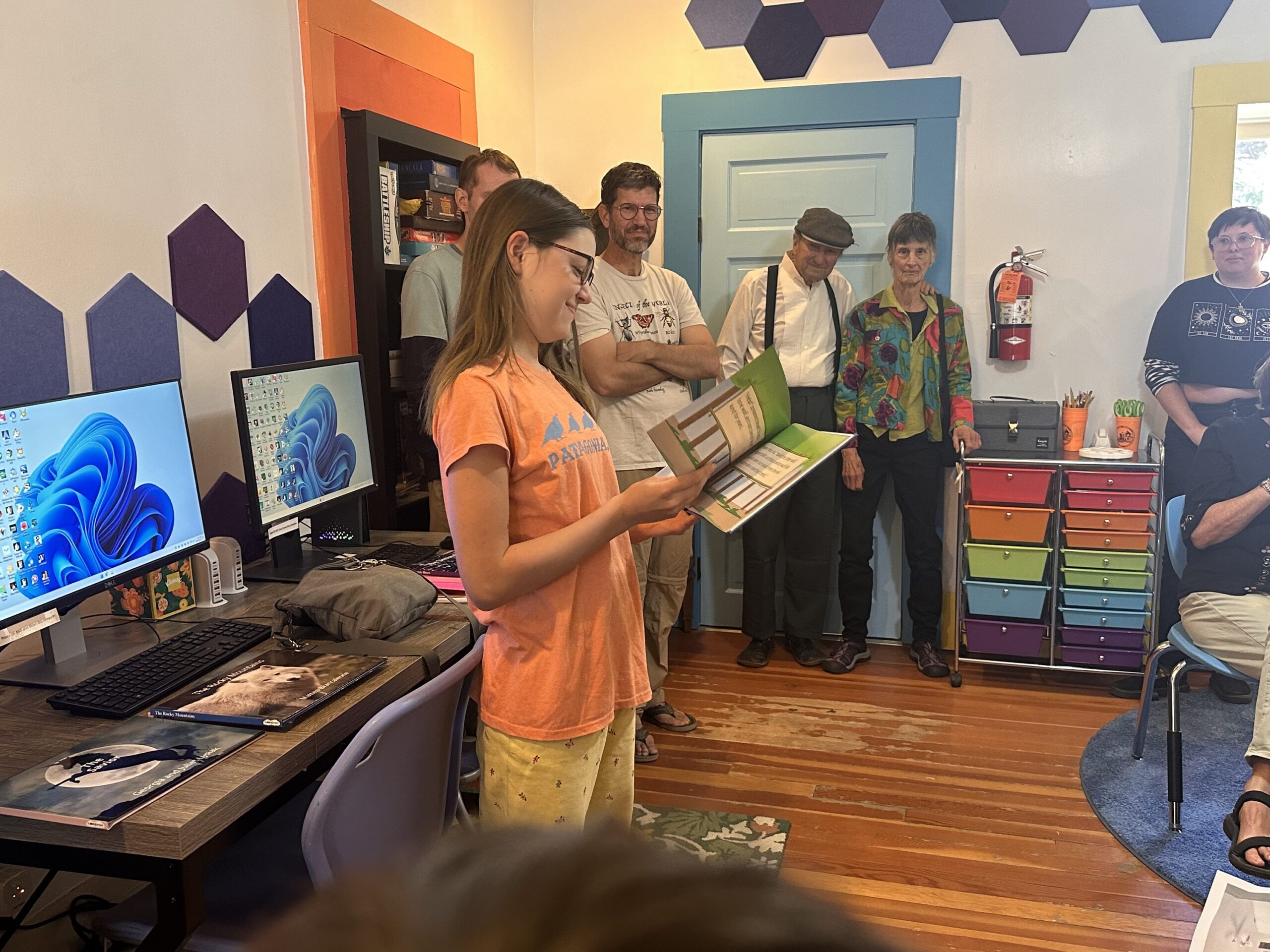
Grand Re-Opening of the Teen Room
The long-awaited grand opening of the revamped Teen Room was held on Saturday, October 19th and was attended by many who had a hand in creating this fun and comfortable space. The backstory is that former library director Kayla Miller had a desire to create a space for the youth of this community that would foster and encourage literacy in a comfortable and safe space. She noticed reading and reading comprehension was a struggle for some teens in town and wanted to be a part of helping them embrace literacy. Ms. Miller applied for a grant through the Library Services and Technology Act Fund and was awarded $10,000.00 in late 2023. Furniture, Laptops, games, books, art supplies, software, and an iPad were purchased to enhance this space.
When Linda Shore, chairman of the Library Advisory Board, heard of Ms. Miller’s teen room makeover she wanted to help. Kayla shared her vision of wanting to have a mural painted on the wall that added color and life to the room which led to Ryan, Linda and Tom Shore graciously donating the money to purchase the art supplies. Local artist Jacqui Treinen helped orchestrate this beautiful endeavor. Jacqui, along with 8 other artists brought the unique work of art to life. This mural, entitled “Books Open Up New Worlds” has been dedicated in loving memory of Sam Shore (1979-2024).
The library staff would like to thank all the artists who contributed to this masterpiece, Jacqui Treinen, David Krest, Gisa Kruegar, Kayla Miller, Benjamin Krzys, Andrew Botz, Thomas Botz, Lily Harsh and Sally Warren. We also send a big thank you to Kayla Miller for her vision and dedication to this project that will benefit the youth in our community.
Check It Out at the Library: What’s New
Reprinted by permission of the Patagonia Regional Times. Written by the Library Team
Looking for something to read to welcome in the new year? We just received a shipment of highly acclaimed bestsellers including:
“Silent Bones” by Val McDermid
“The Librarians” by Sherry Thomas
“Woman in Suite 11” by Ruth Ware
“The Red Queen” by Martha Grimes
“Will-O-The Wisp” by Jenna Gillingham
“The Living and the Dead” by Christopher Carlson
“Shaw Connolly Lives to Tell” by Gilliam French
And the eagerly anticipated latest from Craig Johnson, “Return to Sender”.
Rather watch a movie or a TV series instead? We have almost 2,000 titles in our collection so you’re sure to find something to pique your interest.
We hope you drop by next time you’re in the ‘hood to check out the latest additions to our collections.
The Way It Was
Reprinted by permission of the Patagonia Regional Times. Sondra Porter, author
Last month, a standing-room-only group filled the Patagonia Public Library to listen to longtime locals share their stories about growing up in Patagonia and the surrounding areas, when the region was a much different place from the one we know today. The Mexican border was four strands of barbed wire, and the train ran through the center of town. Muddy corrals served as collection points for cattle being loaded and sent to market in Tombstone. The Patagonia Hotel, constructed in the early 1900s by John Cady, lacked running water and served as a home to one of the speakers.
This was the second in this series of “Living Treasures” oral history events sponsored by the Patagonia Public Library. According to library assistant Jade DeForest, who suggested the idea to the library, plans are underway for a third session in February or March.
During this second installment, stories ranged from growing up with horses, goats, and ponies to attending elementary schools in the Lochiel and Harshaw areas until the buses took them to Patagonia High School in eighth grade. And there was some discussion as to which family had the first TV in town. What was agreed upon was how very tall the TV antennas had to be.
Joe Quiroga started the session by noting he was born in 1937 and lived his early years right near where the speakers were gathered. He pointed to the rooms beyond the library desk and said, “I lived right back there until we moved across the street to the Duquesne House. Spent my growing up years all around here… My uncle lived in the last room back there, and he grew a good vegetable garden in the back.”
Quiroga graduated from Patagonia High School, worked a while on the first stretch of Highway 83 around Gardner Canyon before working on local ranches. He was married in 1957 to Noemi. Three of their children were delivered by Doc Mock—a name that reappeared regularly in the stories of the afternoon.
Quiroga started ranch work by tending livestock and training horses. At the same time, both he and his wife drove school buses for years. Joe eventually retired as ranch manager after working 40 years for the Diamond C Ranch in Canelo. He said he was most proud of his work over the years with reclamation of degraded land by clearing invasive mesquites and building dams with local bamboo and wood from the mesquites. The dams collected rain water and allowed native species to return.
Ophelia De La Ossa Spence, born in 1940 in Lochiel, had equally compelling stories of growing up and attending school in Lochiel and Washington Camp. She had memories of walking to grade school about two miles with her two brothers and a sister.
She started taking the bus 20 miles to Patagonia School in the eighth grade. She assured the group that if you misbehaved too much, “they would throw you off the bus. I know because they did [that] to my little brother once!”
Ophelia liked school, especially math and credited her lifelong interest in sewing to the classes she took there. She also loved playing volleyball which was a school favorite. “I think we were the champions two or three times,” she recalled.
Ophelia graduated with a class of 14, eventually married at 22 and moved away with her husband for about 42 years. She always visited and stayed close to her family, even while living out of state. Years later, after her husband died, she moved back from Nevada when her mom was 98.
Her mom survived until she was 103. Ophelia now lives in Green Valley.
Bob Bergier’s roots were deep as well, even though he was born in Florence, Arizona at the end of World War II. When his dad was drafted his mom moved back to town when he was only a few months old. He lays claim to being a fourth generation Patagonian. Both sets of grandparents lived in the area since around 1900, and his dad was born in town on Pennsylvania Avenue. His family moved back to town in 1951, after the death of his grandfather Bergier. Bob attended school here first grade through high school.
“In 1951 we moved into a real old funky house on Pennsylvania Avenue,” Bergier told the crowd. “My dad tore it down and built a new house…Behind our house there was a jungle-like area and there was all this lumber and carpentry left over from the house…and the Patagonia fire engine was parked there and we would play on that. We had a great time.”
Bergier also had tales of a carnival coming to town. He arranged to buy a local chicken to feed to a python that was with the traveling group. He delivered the chicken on his bike but didn’t wait to see it get devoured.
Bergier earned a B.S. in Art at Northern Arizona University and returned to run the family ranch, following a bit of time in the Army. Since 1976, Bergier and his wife Gayle have worked on the family ranch that in the 1920’s his dad had dubbed “Hard Luck.” Bergier is an accomplished artist whose work often depicts regional scenes and captures the spirit of the area.
Patti Holbrook Oliver, who grew up on a ranch south of town on Harshaw, shared lively tales of filling her time riding horses, because she had neither radio or TV. She became a bit of an escape artist, stealing away from home at night to go visit the neighbors and sneaking out with a friend during a school sleep over through a passageway under the Patagonia High School stage.
She only attended junior high school and one year of high school in town. Her folks eventually sent her off to boarding school in Florida, where she made a connection with Cuban students and took a vacation to Cuba.
During the heyday of filming movies here in Santa Cruz County, Oliver was spotted by a casting director during the making of “Oklahoma” and ended up appearing in seven western movies with the likes of John Wayne and Harrison Ford. Her daughter shared a list of the films with the audience.
Arnulfo (Arnie) De La Ossa was born in Lochiel in 1938 and moved to a house between Lochiel and Washington Camp. His brother had a goat, and he rode a pony all over the hills until he was about 10. “The pony finally got it in for me, and I thought he was going to kick me to death,” he recalled, “so I graduated to a horse.”
Arnie’s tales of summer were filled with sharp contrasts to the typical summers now. The rains were regular, the creeks ran high, and the grass grew thick in his memory. He said. “I grew up cowboying with my family… We took our shoes off in May and kept them off all summer, at least until the 4th of July.”
Abel De La Ossa, Arnie’s father, had about 50-60 head of cattle, so they would separate 5-6 good milking cows out for the three boys to tend during the summers. His mother Armida made “real original” quesadillas, a soft cheese. Around noon every day, the boys would deliver small rounds of quesadilla wrapped in waxed paper to the miners.
“There were lots of mines back then,” he remembered. “We would go to the mines around noon and sell packages to the miners for ten cents each.” On the way home, they would stop at a local store for a soda or piece of candy.
After Arnie graduated from Patagonia High School, he served in the Navy SeaBees, which led to his building knowledge. He was assigned to the construction brigade. After he returned to the area in 1960, he married a local, Marsha Beach, and began working at the Vaca Ranch.
Eventually he left the county for a job in 1964 with Arizona Department of Transportation (ADOT) in Tucson, but the ties to home remained strong. Marsha was able to fulfill her dream of going to college and becoming a teacher. He worked for ADOT as an employee and consultant for a total of 50 years, but the trips back to his roots and family were a constant.
Among those attending the Dec. 6 “Living Treasures” event was Cami Schlappy, historian at the Boman-Stradling History Center in Sonoita, along with her family. She was impressed.
“I brought my daughter so she can see that working on horses, walking to school, and spending the summer barefoot really wasn’t that long ago,” Schlappy noted. “I wanted her to see the people who cowboyed the ranches, worked the mines, and lived in now abandoned places. I hope it gives her a new perspective and understanding about our shared community and the people in it.”
Library assistant DeForest was inspired to propose the gatherings by work she had done before she arrived in Patagonia.
“I had a clinic in northern New Mexico and I got to know so many of the people who were many generations there,” she explained “A lot of them were elderly and dying and I thought we needed to hear their stories. So I set a date at my clinic and so many people showed up that we couldn’t get them all in.
We did it four times actually. I believe in the power of oral histories, and so I wanted to bring that experience here to Patagonia.”
DeForest has been pleasantly surprised at the great turnout and audience response to the events here.
The richness of the participants’ stories was surpassed only by the apparent ties the group had to their shared history and their enduring love and appreciation of the area. During the question and answer period, someone asked how many in the crowd were related in some way to one of the speakers. At least a third of the audience raised their hands.
Video recordings of both “Living Treasures” events are available at the Patagonia Public Library’s YouTube channel: youtube.com/@patagoniapubliclibrary3528
Check It Out at the Library: Photographer Edward S. Curtis
Reprinted by permission of the Patagonia Regional Times. Sarah Klingenstein, author
A new Patagonia Library exhibit highlights American photographer Edward S. Curtis, whose 20-volume set of plates and narrative on the Native Americans was lauded in the 1910s, but then languished in rare book rooms and the publisher’s basement until their discovery in 1972.
One of the four fantastic Curtis books the library has on display—and the only one not available for checkout—is “Portraits from North American Indian Life,” measuring 18 by 14.5 inches and containing over 80 large images on heavy paper. These portraits and “slice of life” photos are a rich look into the world Curtis captured for posterity.
One of the two biographies in the collection, “Short Nights of the Shadow Catcher” by Timothy Egan, fleshes out the details of Curtis’s life and exciting work.
Curtis’s first attempt at memorializing native peoples was his 1895 photograph of the daughter of Chief Sealth of Seattle. Moved by a fervent desire to chronicle traditional Native American life before its certain disappearance, over the next 30 years Curtis spent months at a time away from his wife and children as he studied, befriended and photographed tribal peoples from the Nunivak of Alaska to the Hopi of New Mexico. Although much of his research was funded by financier J.P. Morgan, Curtis died in 1952 with his work largely unknown.
As Library Clerk Anne Vogt observed, “When you see a portrait that shows such intimacy, you know the photographer or painter has spent the time and earned the trust of their subject.” That couldn’t be truer than in the case of Edward Curtis. Come check out this gorgeous display, and take one of the books home with you
Running With The Big Dogs
Reprinted by permission of the Patagonia Regional Times. Mary Tolena, author
“People want to hear from you!” was Patagonia Public Library Assistant Jade DeForest’s answer when author Phil Caputo asked why she was inviting him to speak at the library at the end of March. “It’s a stressful time. We want to hear from each other, and especially from people like you.”
Indeed, DeForest was correct: Cady Hall was full, with over 90 listeners eager to hear Caputo’s words and wisdom.
“I am gratified as well as amazed at how many people showed up,” Caputo said. “By the way, this is my favorite town in the whole world!”
That’s saying a lot, considering that Caputo has traveled to 58 countries throughout his long career as an international journalist and author. His 18 novels and non-fiction books include “The Longest Road: Overland in Search of America from Key West to the Arctic Ocean,” about an epic road trip that covered 17,000 miles in four months. In other words, the guy has been places!
Caputo grew up in the western suburbs of Chicago, and got his start in journalism in 1968 as a reporter for the Chicago Tribune, after a 16-month tour of duty in Vietnam. Four years later, he became a foreign correspondent for the Tribune, covering Rome, Moscow, the fall of Saigon, and the Lebanese civil war. He left journalism to focus on writing books in 1977 after being seriously injured in the Beirut conflict zone (see below).
When asked by an audience member, “How did you get to Patagonia?” Caputo credited his close friend and fellow author, the late Jim Harrison, whom Caputo knew from their bird hunting days in Michigan. Jim and his wife Linda had been wintering in Patagonia for several years and they invited Phil and his wife Leslie to visit in 1998. “The Town of Patagonia is unusual,” Harrison told them. “Not your typical Mayberry.”
Leslie and Phil found that to be true—and made an almost immediate decision to make Patagonia their winter home, too.
Harrison and Caputo remained close friends, sharing hunting trips and drinks at the Wagon Wheel until Harrison’s death in 2016. “Being friends with Jim was something of a job,” Caputo said. He recounted one of their adventures in his article “One Night in the Canyon” in the PRT shortly after Jim’s passing.
At the Library Author Talk, Caputo (now age 84) said, “in advancing age, one wonders if one’s life has added up to anything.” The talk encompassed his thoughts on that question, with reflections on three incidents in his career.
The first was about capturing his first scoop as a cub reporter for the Chicago Tribune. It involved overcoming his fear of heights to scramble the 200-foot-high fire escape and catwalks of the prestigious Palmer House Hotel to circumvent the police blockade of the hotel room where a murder had taken place. Caputo reached the window, saw the whole scene, and quickly wrote up the gory details for the paper’s next edition.
Determined to show that he could do whatever it took to get the story first, he knew he also had to fiercely protect his scoop. And so the poor competing journalist who had caught on to what Caputo had done found himself locked in the hotel’s phone room until after his paper’s deadline. “I had proved that I could run with the big dogs,” Caputo said.
A few years later, Caputo said, “I was a Big Dog” as a foreign correspondent in the Tribune’s Middle East bureau during the Lebanese civil war. In the conflict between Christians and the Palestine Liberation Organization, Caputo saw the “worst kind of fighting between people,” and developed a kind of “emotional flak jacket” to deal with the trauma happening around him.
Caputo’s second life reflection was about a particularly gruesome incident where a rocket landed nearby and killed 13 women who were standing in line to buy bread. At the time, Caputo had to compartmentalize their fates as “collateral damage” as he pursued news about the war’s power players and their strategies.
The third incident came four months later, when Caputo was assigned to cover a new phase of the war. To him and his fellow correspondents, it was basically a suicide mission into high-conflict territory.
Sure enough, they were stopped by Muslim militants. After a disagreement about their press cards, they were let go, but were followed by two gunmen. As they ran zigging and zagging, Caputo was hit by shrapnel, then by a bullet that shattered his ankle.
Luckily, Caputo had fallen in a Christian-held street, where he crawled into a building and miraculously found a vascular surgeon taking shelter there. He eventually reached a hospital in the middle of the war zone, where he was treated with no anesthesia. The pain was like nothing he’d ever felt before or since.
Eventually, he was evacuated back to his parents’ house in the same Chicago suburb he’d been so eager to leave as a young adult. During his rehab time, as he progressed from wheelchair, to crutches, to a cane, Caputo wrestled with the big question of Why? Why was I shot? Why did this happen to me?
He eventually realized that it was up to him to supply the answers, and in fact “Why?” was not the important question. “What was important was what I made of it,” Caputo said.
One thing he made of it was his first book, his best-selling Vietnam memoir, “Rumors of War.” He got the book contract and finished the manuscript in nine months while recovering.
Reflecting further on his traumatic incident, Caputo said that having to wrestle with loss, injury and anguish can call forth the best in us, too. He recalled the 13 women in the breadline, whom he had “callously dismissed as collateral damage.”
“I concluded that I had been wounded to know what suffering really meant,” Caputo said. “I had been meant to relearn compassion.”
Caputo is now working on another book, a collection of short stories called “Wandering Souls,” which will be published in late 2025 or early 2026. His other books are available at the Patagonia Library, and are described on his website, PhilipCaputo.com, along with his “Dispatches”of current political commentary.
Relive Phil’s talk on the Library’s YouTube channel.
New Club Finds Health in the Spices of Life
Reprinted by permission of the Patagonia Regional Times
Fifty free turmeric samples.
That’s what Jade DeForest prepared in launching of The Spice Club, an herbalicious group recently formed through the Patagonia Public Library.
Turns out DeForest underestimated interest. Back into the kitchen she skedaddled to make 50 more sacks.
“I really did not expect the response,” DeForest said. A Sonoita resident and Patagonia Library employee, DeForest ran with a suggestion given to her by Summer Smith, former library administrator.
And—snap—the idea seems to have taken off with the community: Free spice samples given out monthly, with a meeting to share recipes and ideas (held at 2 p.m. on the third Friday of the month at the library).
That this was an easy suggestion for DeForest to embrace is a given. No stranger to the concept of “food as medicine,” DeForest served as an herbal pharmacist in Ojo Caliente, N.M. Now she’s delighting local residents with her expertise on a subject she is passionate about.
“All spices have medicinal qualities,” she said. Turmeric is a powerful example of that, as it is used in both Chinese and Indian systems as an anti-inflammatory and treatment for Irritable Bowel Syndrome, among other things.
But turmeric is just the start of this culinary and medicinal adventure. In March the focus will be ginger. After that, who knows—lobelia, used for asthma and depression; chaparral, assisting with arthritis and the common cold; white willow bark, which helps with pain and inflammation; and dill, assisting with flatulence and digestive disturbances.
“Our ancestors found medicinal uses for herbs as early as 3,000 BC,” said food writer Beth Dooley who co-authored the book Chile, Clove, and Cardamom with Patagonia scholar Gary Paul Nabhan. “Ginger, turmeric, garlic, juniper and elderberries were used as treatments for a number of conditions, brewed into teas for respiratory conditions, pounded into [poultices] for wounds, burns and sores.”
Ginger, the Spice Club’s focus in March, is a favorite of Dooley’s. “I’m a huge fan of ginger for its warming properties—brewing it into teas, adding it to stir fries, soups and stews. It, too, is known to contain potent anti-inflammatory properties, support digestion, balance blood sugar and support heart health.”
Now the million-dollar question: heath-wise, which is better—fresh or dried?
According to the website superfoodly, dried herbs have higher antioxidant concentrations than fresh. This is because fresh are largely water. Fresh herbs, too, need to be used promptly. As for dried, varieties should be stored in a dark cool location to maintain their flavor and potency.
Hot off the Press…
There is nothing we love more than inviting local authors to read their creations to our patrons. During the recent opening of the revamped Teen Room, we were lucky enough to have four of the six recent graduates of the Universe Within STEAM World Building program join us to read excerpts from their novels. They entertained us with tales of superhero characters who solve major social or environmental problems in their worlds.
And the great news is all these books are now available for checkout at the Library!! You too can be inspired by the world the youth of our community envision.
Click here for more information about the fabulous Universe Within program, designed and offered at no charge by the Mat Bevel Company.
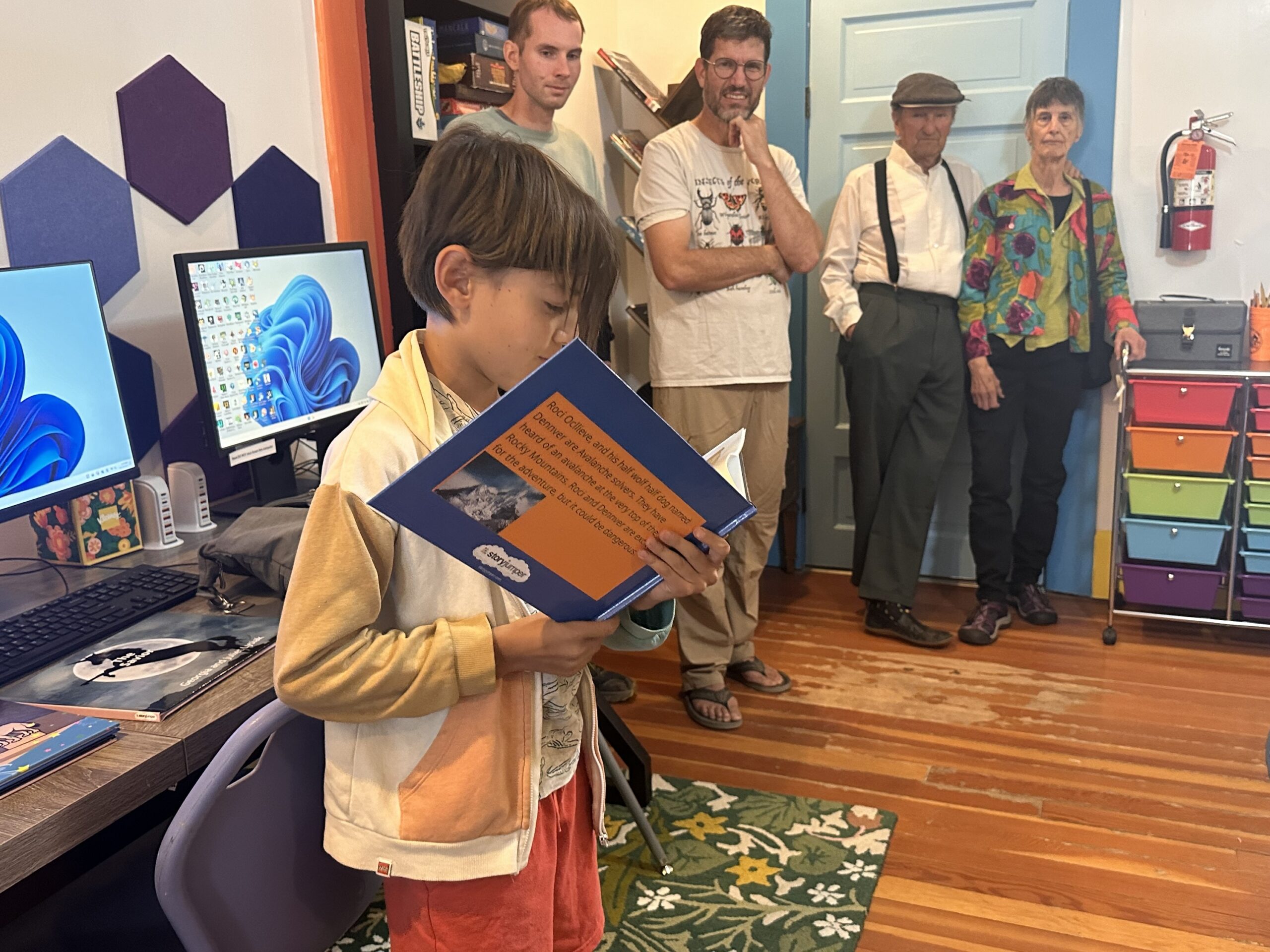
Grand Re-Opening of the Teen Room
The long-awaited grand opening of the revamped Teen Room was held on Saturday, October 19th and was attended by many who had a hand in creating this fun and comfortable space. The backstory is that former library director Kayla Miller had a desire to create a space for the youth of this community that would foster and encourage literacy in a comfortable and safe space. She noticed reading and reading comprehension was a struggle for some teens in town and wanted to be a part of helping them embrace literacy. Ms. Miller applied for a grant through the Library Services and Technology Act Fund and was awarded $10,000.00 in late 2023. Furniture, Laptops, games, books, art supplies, software, and an iPad were purchased to enhance this space.
When Linda Shore, chairman of the Library Advisory Board, heard of Ms. Miller’s teen room makeover she wanted to help. Kayla shared her vision of wanting to have a mural painted on the wall that added color and life to the room which led to Ryan, Linda and Tom Shore graciously donating the money to purchase the art supplies. Local artist Jacqui Treinen helped orchestrate this beautiful endeavor. Jacqui, along with 8 other artists brought the unique work of art to life. This mural, entitled “Books Open Up New Worlds” has been dedicated in loving memory of Sam Shore (1979-2024).
The library staff would like to thank all the artists who contributed to this masterpiece, Jacqui Treinen, David Krest, Gisa Kruegar, Kayla Miller, Benjamin Krzys, Andrew Botz, Thomas Botz, Lily Harsh and Sally Warren. We also send a big thank you to Kayla Miller for her vision and dedication to this project that will benefit the youth in our community.

The Seed Lending Library
Bring a few. Take a few.
No matter the season, the Semilloteca Seed Library is always open, and we are looking for seed donations to expand our offerings to our growers.
Bring some seeds to share and take some home to plant.
Author Talk by A. Thomas Cole
Reprinted by permission of the Patagonia Regional Times
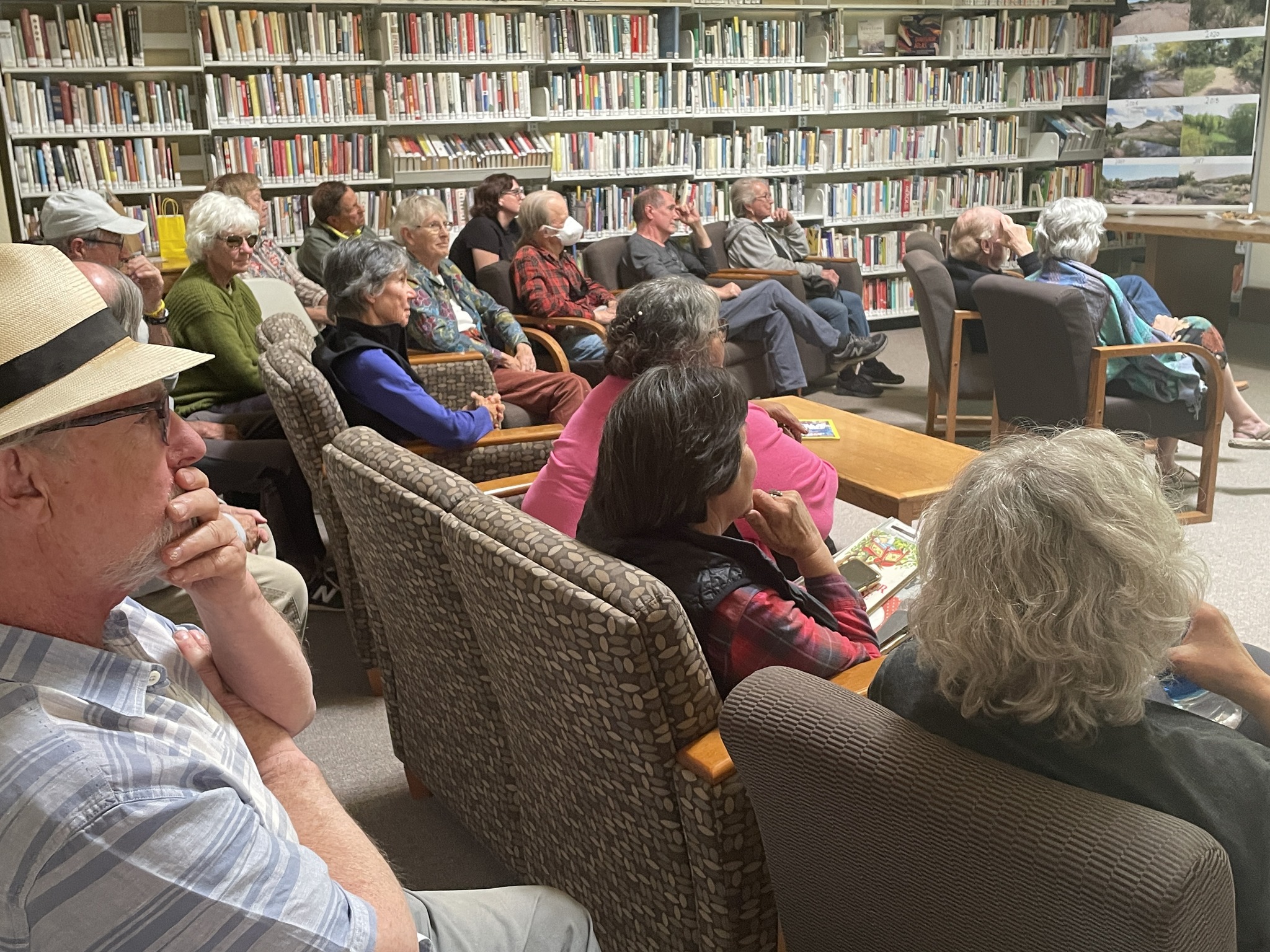
Today the 11,300 acres that make up the Pitchfork Ranch provide an important setting for carbon sequestration, wildlife habitats, and space for the reintroduction of endangered or threatened species.
Middle Schoolers Visit the Library
Reprinted by permission of the Patagonia Regional Times
Every so often, a group of middle schoolers and their teachers will come visit the library before our opening hours to have a full hour of undivided attention and assistance from the library staff.
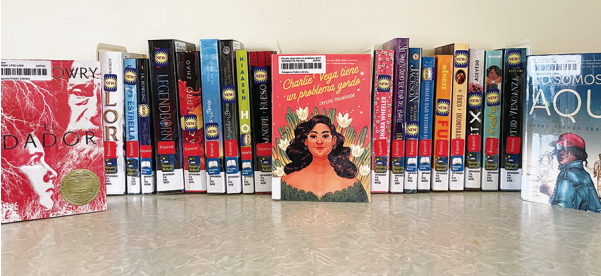
As hectic as these mornings can be, I love having the chance to get to know the kids, understand what they’re looking for, and showing them that the library is here to help however we can.
During their visit in March, the kids pointed out something lacking at our library – books in Spanish! At least a third of them came into the library looking for Spanish books and found a meager handful. Desperate to fulfil their reading needs before their next visit, the library has added around two dozen Spanish chapter and YA books.
I highly encourage everyone, regardless of their fluency level, to try one of these books! Not only are YA/chapter books fun to read, reading in multiple languages is a great workout for your brain. Whether you are a fully fluent, native speaker looking to enjoy a good story, a beginner looking for something simpler to read, or someone just honing their Spanish skills, this new collection of books will have something for you.
The Graphic Novel Genre
Reprinted by permission of the Patagonia Regional Times
Graphic novels, manga, comic books, and the like continue to be an incredibly misunderstood genre. One of the complaints I hear most often from parents is that their kids keep reading comic books instead of “real books.”
Well, I have great news for all frustrated parents out there: comic books are great for your children’s reading comprehension! A 2014 study published in The International Electronic Journal of Elementary Education found that in addition to student enjoyment, “the use of graphic novels also improved student comprehension and deeper understanding of reading material.”
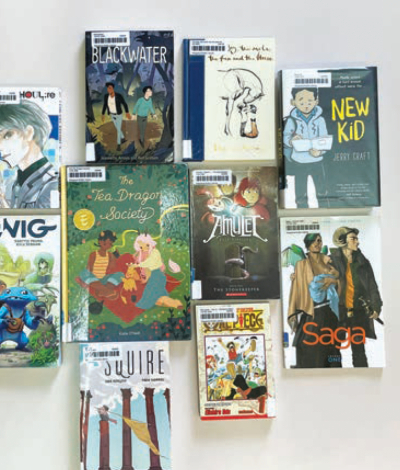
Comic books can also introduce complex issues. “Squire” by Nadia Shammas, for example, covers topics such as racism and discrimination in a story that is easy for kids to understand and learn from.
For those who are not familiar with graphic novels, let me tell you, they are really fun to read! The use of illustrations and other art forms can create a beautifully immersive reading experience for all ages, not just for children. “The Boy, the Mole, the Fox, and the Horse” by Charlie Mackesy, is a graphic novel that explores anxiety and societal expectations that many adults feel. “Maus: My Father Bleeds History” by Art Spiegelman, tells the story of one man’s experiences in a Holocaust concentration camp, and how his trauma ended up affecting his children as well.
Give graphic novels a chance… and let your kids read them too!
Foodies are Always Welcome
Reprinted by permission of the Patagonia Regional Times
As the year comes to an end and the winter approaches, everyone has just one thing on their mind: good food. No? Just me? For anyone who shares the same love of food, the Patagonia Library has great book options for you.